2026-09-28



2026-02-25 | by Joydip Manna
Water treatment confusion happens almost daily inside industries honestly. Client says, “Need pure water.” Consultant immediately suggests RO plant. Operator says softener already available. Purchase department mostly asking only one thing — lowest budget possible.
But actual requirement many times nobody defines properly.
What conductivity needed. What TDS acceptable. What boiler pressure operating. What final application planned.
That is where actual problem starts.
Cooling tower water, boiler feed water, pharma water and drinking water all cannot use same treatment logic. Still many systems designed using shortcut assumptions only. Later membrane scaling begins, conductivity becomes unstable, resin exhausts quickly and boilers start developing deposits.
Reality actually much simpler than industry confusion.
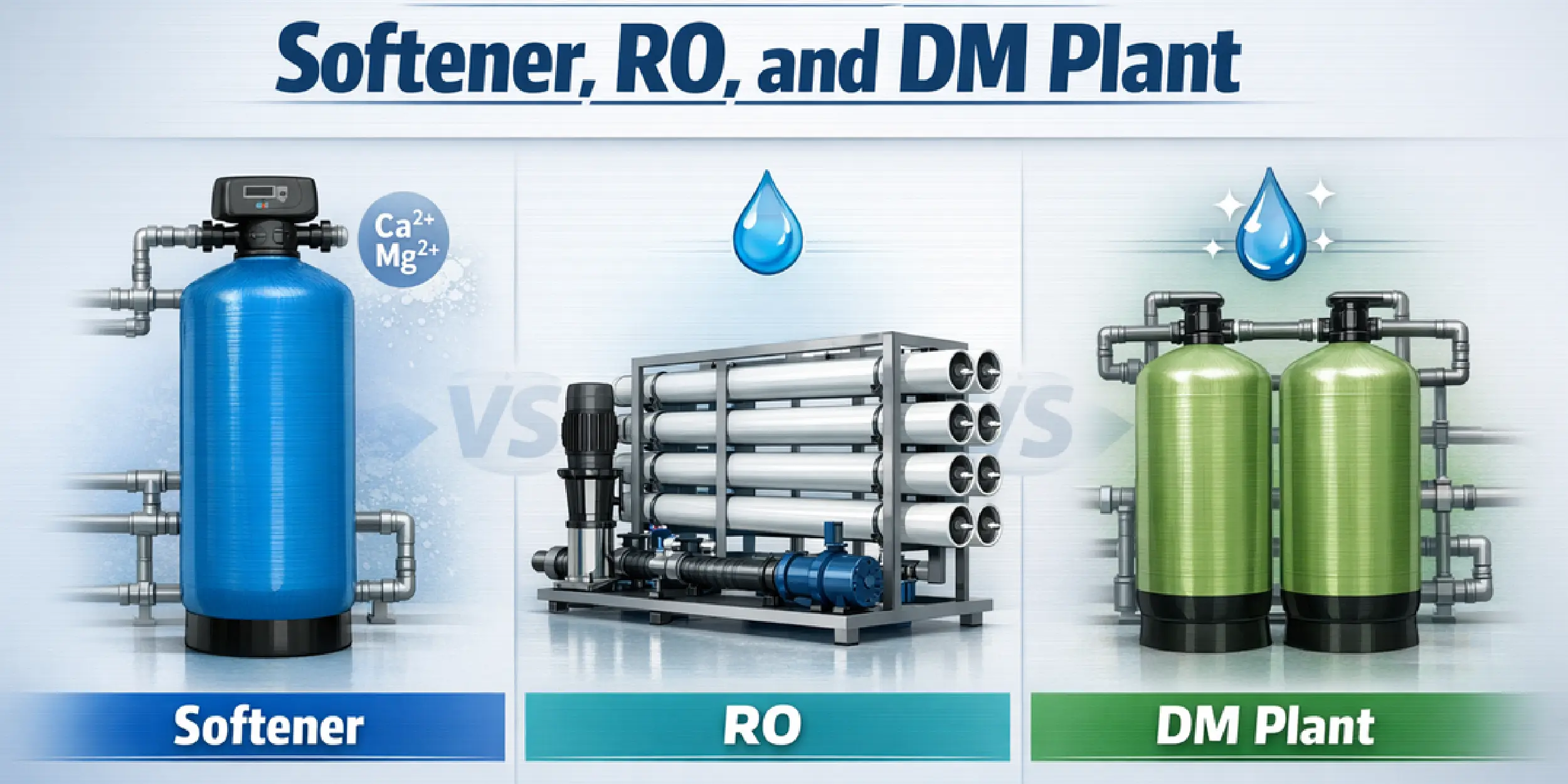
Softener, RO plant and DM plant are three completely different technologies. Different purpose, different output quality and different operating complexity. One system cannot blindly replace another.
Before selecting any treatment system, proper raw water analysis must happen first. This step many projects ignore completely.
Parameters like TDS, hardness, silica, iron, chlorides, sulphates and conductivity target decide entire treatment logic. Boiler pressure also matters heavily.
Without these values, system selection becomes mostly guesswork only.
Another major mistake industries make is focusing only on project cost. Actual problems usually come later through operating cost — membrane replacement, chemical consumption, resin regeneration, scaling downtime and reject handling.
That is why proper selection matters more than simply buying equipment.
A water softener mainly removes hardness from water. Hardness mostly means calcium and magnesium ions present in raw water.
Softener works using ion exchange resin where calcium and magnesium exchanged with sodium ions.
Reaction approximately works like this:
Ca2+ + 2NaR → CaR2 + 2Na+
Later the resin regenerated using common salt solution.
One important misunderstanding repeated across industries — softener removes hardness only. It does not reduce TDS. It does not remove chlorides, sulphates, silica or nitrates.
For example, if raw water TDS is 1800 ppm, after softener also TDS remains nearly same. Conductivity also remains almost unchanged.
That is why softened water alone usually unsuitable for high-pressure boilers, turbine systems, pharmaceutical water or electronics manufacturing.
Softener mostly used for cooling towers, HVAC systems, textile units, laundry applications and RO pretreatment.
One practical issue seen regularly is iron fouling. If iron continuously enters softener, resin fouling starts quickly and hardness leakage increases badly even when regeneration cycle looks proper.
RO plant mainly used for dissolved salt removal.
RO works using semi-permeable membrane and pressure. Water passes through membrane while dissolved salts rejected.
Generally RO removes around 95–99% dissolved salts depending on membrane condition, pressure and feed chemistry.
If feed water TDS is 2000 ppm, RO permeate may become around 40–100 ppm normally.
RO is not simple filtration system. This confusion also very common. Many clients compare RO with cartridge filter or sand filter although membrane separation process completely different and much more sensitive.
RO performance depends heavily on pretreatment. Typical industrial arrangement usually remains:
Raw Water → Sand Filter → Carbon Filter → Softener → Cartridge Filter → RO
If pretreatment ignored, membrane life drops very quickly.
Very common field situation honestly — operators bypass softener to save salt consumption. Hardness enters membrane section. Scaling starts. Differential pressure rises. Frequent CIP cleaning becomes necessary. Membrane life reduces badly.
Another major issue now becoming important is RO reject disposal. CPCB becoming increasingly strict because high-TDS reject can create groundwater salinity and environmental problems.
That is why many industries now moving toward ZLD systems, MEE and recovery optimization especially in textile, pharma and chemical sectors.
DM plant means Demineralization Plant.
This system removes nearly all dissolved ions from water and produces ultra-pure water. Typical setup includes cation exchanger, anion exchanger and mixed bed system.
Final conductivity may reach below 1 µS/cm, much lower than standard RO water.
DM systems mainly used in high-pressure boilers, power plants, turbine systems, semiconductor manufacturing and pharmaceutical applications.
High-pressure boilers extremely sensitive toward silica, sodium leakage and conductivity increase. Even small silica carryover can damage turbine blades badly. That is why RO alone many times not sufficient for critical boiler systems.
DM plants provide very high purity water but operation becomes more difficult. System requires acid regeneration, caustic regeneration, neutralization system and skilled operators.
If raw water TDS high, chemical consumption rises heavily and operating cost increases sharply.
Modern industries now slowly shifting toward combinations like:
Raw Water → Softener → RO → Mixed Bed
Instead of conventional full DM systems.
Reason mostly practical.
Softener protects membrane from hardness scaling. RO reduces dissolved salts. Mixed bed finally polishes conductivity.
In pharma and power sectors, RO + EDI systems also becoming increasingly common where continuous ultra-pure water required.
One very common mistake is calling RO water as DM water. Many plants call 30–50 µS/cm RO water “DM water” even though actual DM quality much lower conductivity required.
Another repeated mistake is using softener for high-TDS problems. Softener cannot reduce chlorides or sulphates. If borewell water already saline, softener alone solves nothing.
Industries also try extremely high RO recovery without proper silica calculations. That usually creates severe scaling problems later.
Pretreatment removal to reduce CAPEX is another repeated mistake. Initial savings look attractive, but membrane replacement cost later becomes much higher.
Selecting water treatment system using vague phrase like “need pure water” creates many industrial failures honestly.
Correct engineering should always start from proper water chemistry analysis:
Wrong system selection eventually creates scaling, membrane fouling, conductivity instability, high operating cost and expensive downtime.
At Plizma Technology, focus remains more on practical process integration and stable long-term operation rather than simply supplying equipment.
Because in industrial water treatment finally, water chemistry decides everything.
👉 Also read:
Common Mistakes that the Auto Industries Make in Sewage Management
Contact:
Click Here
Last updated on: 2026-02-25
2026-09-28
2026-09-23