
2026-09-28



2026-04-16 | by Joydip Manna
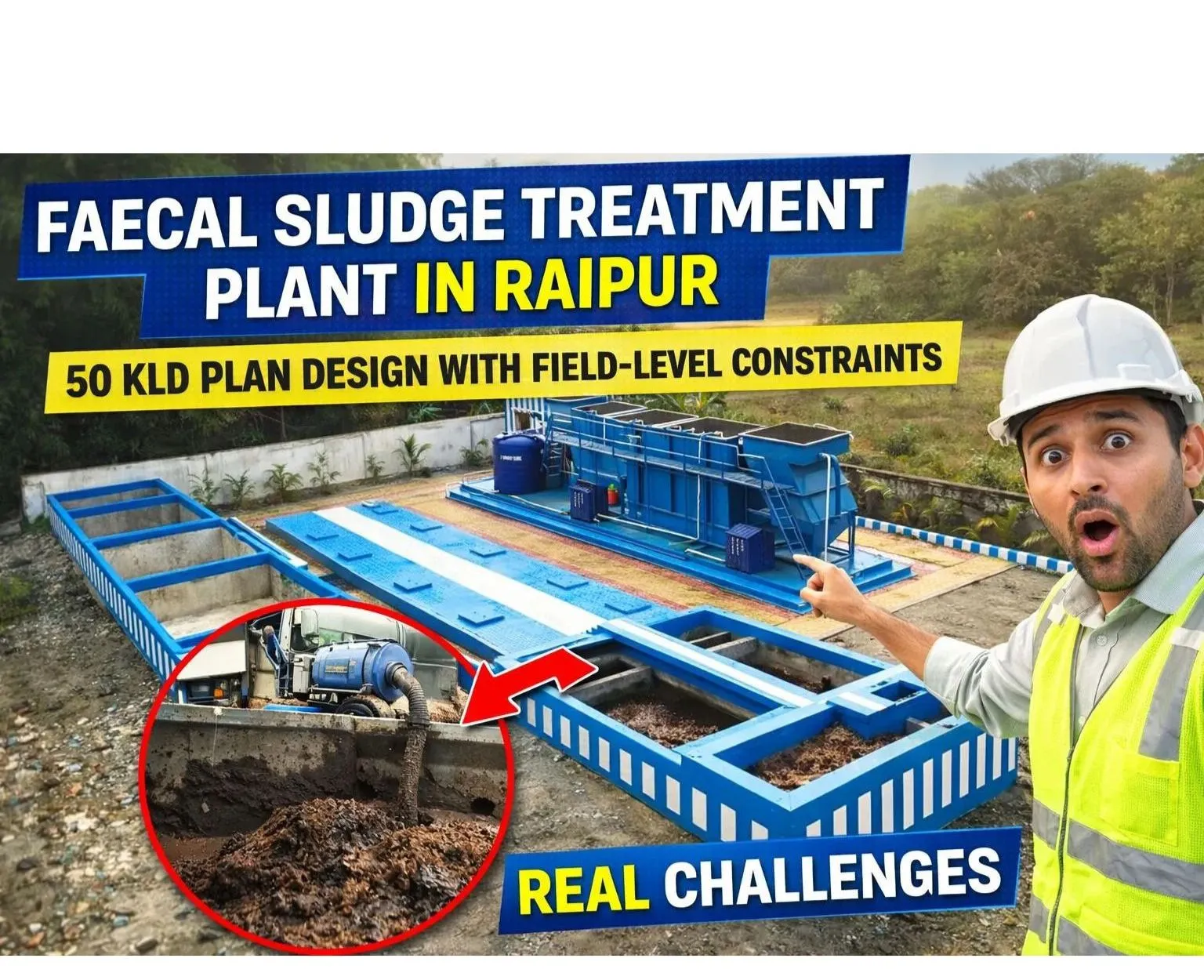
This Faecal Sludge Treatment Plant in Raipur project did not start like a typical design exercise. Initially, there was confusion — many assumed it would behave like an STP or even an ETP system. In reality, it is completely different.
In Raipur, most households rely on septic tanks, and sewer networks are limited. Sludge arrives through tankers, not pipelines. That changes the entire design approach.
Flow is not continuous — some days no load, other times 8–10 tankers arrive together. Designing this as a steady-state system would lead to failure.
The sludge itself is much stronger than sewage — thick, partially digested, sometimes with BOD exceeding 10,000 mg/L. It also contains plastics, cloth, and sanitary waste.
On paper, the requirement was a 50 KLD FSTP Plant in Raipur, but the practical challenges were much more complex:
High aeration systems were avoided — operational cost would become unsustainable.
One common mistake in many cities is trying to apply activated sludge or SBR processes.
These systems require stable, continuous flow. In FSTP, sludge arrives in batches, and even a single tanker can shock-load the system.
Also, high solids content leads to choking in biological systems.
Instead, the approach used was:
Slower process, but far more stable.
Tankers discharge into the receiving station.
Key issue: Screening
Heavy particles are removed at this stage.
If ignored, pumps fail within weeks — already observed in other installations.
Initial separation of solids and liquid begins here.
Detention time is critical — rushing flow leads to overload downstream.
This is the core of the system.
No machinery — only sand, gravel, and plants.
Process takes time. Overloading leads to silent failure.
Plants like Canna support oxygen transfer and structure stability.
Leachate from drying beds flows into:
Simple system — works well if loading is controlled.
Typically done through chlorination.
UV may be used depending on budget.
Final output is semi-solid sludge cake.
If properly stabilized:
Otherwise:
Future direction is resource recovery — nutrients like phosphorus are increasingly seen as valuable.
Also, land requirement is often underestimated. FSTPs are not compact like packaged STPs.
As per CPCB guidelines:
In FSTP, compliance is not only about effluent — sludge safety is equally important.
Centralized sewer systems are not feasible everywhere. Pipeline networks alone can consume up to 70% of project cost. FSTPs offer a practical decentralized solution.
Cities across Chhattisgarh are increasingly adopting decentralized sanitation solutions and faecal sludge management systems where sewer networks are limited.
System became predictable, which is the real success in FSTP operation.
FSTP is simple in design, but requires strict operational discipline.
But when managed properly:
Q1. Can FSTP replace STP?
No. It complements STP for non-sewered areas.
Q2. Biggest mistake cities make?
Underestimating sludge variability.
Q3. Is power requirement high?
No. Much lower than aeration-based systems.
Q4. Why do odour issues occur?
Improper sludge handling, overloading, and uncontrolled anaerobic conditions.
Q5. Can sludge be reused?
Yes, but only after proper stabilization as per guidelines.
Projects like this are not about technology innovation — they are about understanding real field conditions.
India’s sanitation challenge is not lack of technology, but mismatch between technology and ground reality.
FSTPs in cities like Raipur are no longer optional — they are essential infrastructure.
From Plizma Technology perspective, the approach remains consistent:
Keep it simple. Keep it robust. Design for operator reality — not for presentation drawings.
2026-09-28
2026-09-23