




2026-04-06



2026-02-25 | by Joydip Manna
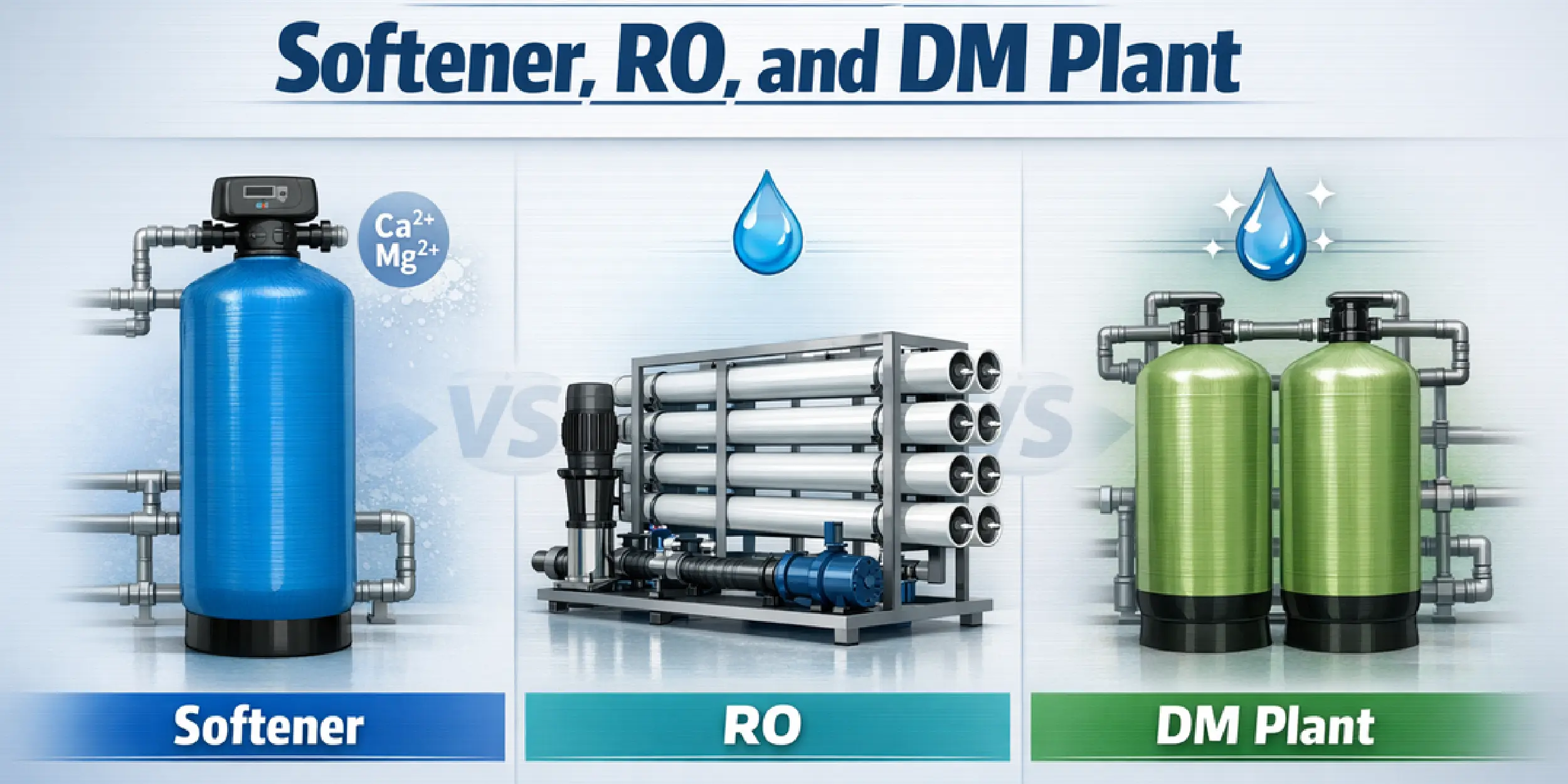
Water treatment confusion we see this daily in industry. Client says “need pure water”, but not clear what purity, what TDS, what hardness, what application. Softener, RO, DM — all three are different tools, not interchangeable. If selected wrong, plant fails, scaling happens, resin exhausted fast, membranes choke. So we explain clearly here, practical side, regulatory side, and what really happens inside plant.
A water softener plant removes hardness only.
Hardness = Calcium (Ca²⁺) + Magnesium (Mg²⁺)
It works on ion exchange principle.
Calcium/Magnesium replaced by Sodium (Na⁺).
Resin reaction example:
Ca²⁺ + 2NaR → CaR₂ + 2Na⁺
Regeneration done using brine (NaCl solution).
As per IS 10496 (BIS boiler water standard)>, desirable hardness for drinking water is 200 mg/L (as CaCO₃), permissible 600 mg/L.
Softener helps meet hardness criteria but does not ensure potable quality because TDS remains unchanged.
WHO guidelines also do not mandate zero hardness — scale control in industry is operational requirement, not drinking requirement.
Operators mistake soft water as pure water. But TDS remains same. If raw water TDS = 1500 ppm, after softener still ~1500 ppm. Only hardness replaced by sodium.
Scaling reduces, yes. But conductivity stays same.
Works on semi-permeable membrane under high pressure.
Pressure applied greater than osmotic pressure.
If raw water TDS = 2000 ppm
RO permeate may be = 50–100 ppm
Depends membrane quality, recovery %, fouling, scaling control.
For drinking water in India, CPCB discharge norms regulate reject water disposal for industrial RO plants.
WHO drinking water guideline for TDS: < 1000 mg/L generally acceptable.
RO typically meets potable TDS levels.
RO needs pretreatment:
RO alone not stable without proper pretreatment.
DM Plant removes almost all dissolved ions.
Final output conductivity can be 0.1–1 µS/cm.
TDS near zero.
For boiler feed water, IS 10496 (BIS boiler water standard) specifies strict limits for silica, sodium, conductivity.
Aligned with AWWA and ASME boiler guidelines internationally.
RO cannot alone meet ultra-low conductivity needed for high-pressure steam generation. DM polishing required.
Now many industries use RO + Mixed Bed instead of full DM for cost balance.
| Parameter | Softener | RO | DM Plant |
|---|---|---|---|
| Removes Hardness | Yes | Yes | Yes |
| Reduces TDS | No | Yes (95–99%) | Yes (~100%) |
| Removes Silica | No | Partial | Yes |
| Output Conductivity | Same as raw | 10–100 µS/cm | <1 µS/cm |
| Chemical Regeneration | Salt | No (membrane cleaning only) | Acid + Caustic |
| CAPEX | Low | Medium | High |
| OPEX | Low | Medium | High |
Use Softener if:
Use RO if:
Use DM if:
Common combination:
Raw Water → Softener → RO → Mixed Bed
Each stage protects next stage. Skipping stages increases failure rate. Seen repeatedly in field audits.
Not for high-pressure boilers. Ultra-low conductivity needed. RO alone cannot guarantee <1 µS/cm consistently.
In most Indian groundwater conditions yes. Hardness above 200 mg/L causes membrane scaling.
RO + EDI or RO + DM + UV. Must meet pharmacopeia standards (IP, USP). Conductivity and TOC strictly monitored.
Not reliably. Ion exchange removes ions, not biological contamination. UV or ultrafiltration required.
RO produces reject (30–50%). Softener and DM produce regeneration waste requiring neutralization before discharge.
Water treatment selection should never be guesswork. Misunderstanding between softening, desalination, and demineralization costs lakhs in membrane replacement, boiler tube failure, turbine scaling.
At Plizma Technology, we see wrong combinations more than wrong equipment. Design must align with raw water report, pressure requirement, regulatory framework, and lifecycle cost — otherwise plant becomes liability, not solution.
👉 Also read:
Common Mistakes that the Auto Industries Make in Sewage Management
Contact:
Click Here
Last updated on: 2026-02-25
2026-04-06

2026-03-24