
2026-09-28



2026-04-22 | by Joydip Manna
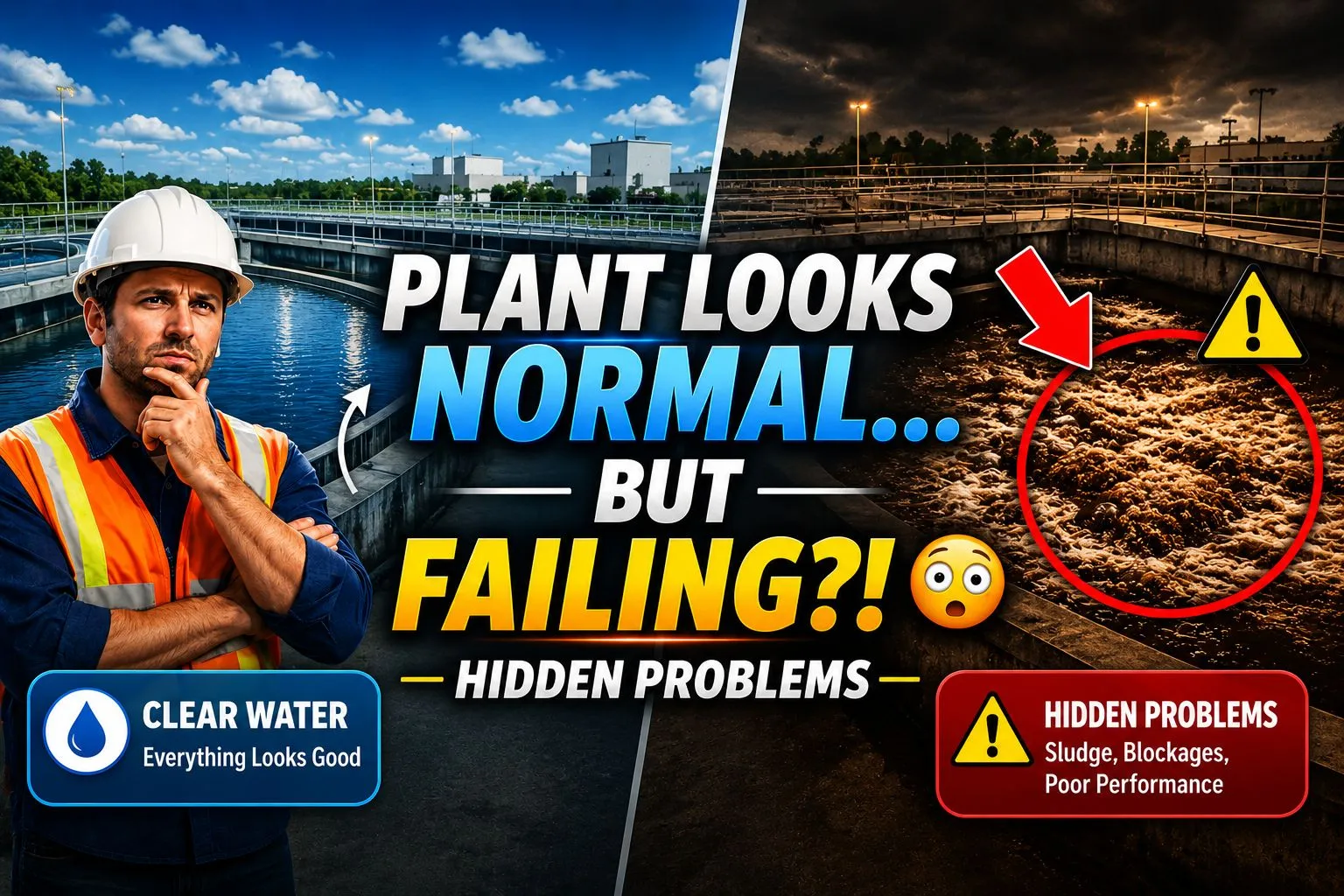
You check the report — BOD fine, COD fine, pH perfect, TSS under control. On paper, the plant looks almost textbook.
Still… smell coming, sludge behaving strangely, discharge sometimes rejected, operators struggling.
This situation is very common.
And the reason is simple — but usually ignored:
Treatment plant performance is not equal to lab parameters.
Regulators like CPCB, WHO, and USEPA define discharge limits.
But these limits are:
They do not reflect what is happening inside the treatment process.
So yes — your outlet water may be “legal,” but your process may already be unstable.
Activated sludge is not machinery — it is living biomass.
In many cases:
System appears stable… until:
This is delayed failure.
Equalization is designed to stabilize flow, but in reality:
Instead of one visible shock, you get continuous low-level stress — harder to detect, but more damaging.
A common issue in plants:
So reports show best-case conditions.
But plant operates 24 hours — night discharge, peak loads, batch releases are missed.
You are judging the plant from one snapshot, not full operation.
Most plants track:
But ignore:
You may still see:
Failure then appears sudden — but it was building slowly.
Design assumptions rarely match real operation:
Plant adapts temporarily, but long-term stability is lost.
DO meter may show 2 mg/L, but inside tank:
Some zones become septic while others remain aerobic.
This imbalance is not immediately visible in outlet parameters.
Common in many ETPs:
Result:
Short-term compliance, long-term failure.
Sensors may:
SCADA shows stable operation, but actual process is different.
Over-reliance on instruments without verification leads to wrong decisions.
A treatment plant can meet CPCB norms and still be operationally unstable.
Because:
These are not the same.
Plants often operate in adjustment mode, not controlled mode.
Because:
All are correct — but incomplete.
Why does wastewater treatment fail?
Due to poor design, load variation, and biological treatment failure in ETP.
What causes high COD in industrial wastewater?
Shock loads, poor equalization, and incomplete treatment lead to high COD wastewater treatment issues.
How to improve ETP efficiency?
Maintain sludge balance, optimize aeration, and control load for better ETP efficiency improvement.
Why is my plant not meeting compliance?
Overloading, sludge issues, and poor operation cause ETP not meeting compliance norms.
Treatment plants do not fail suddenly. They fail slowly — quietly — while reports still look perfect.
By the time parameters go out of range, the system has already been unstable for days or even weeks.
That gap — between what is measured and what is actually happening — is where most failures begin.
From field observations, including projects handled by Plizma Technology , the issue is rarely just design or compliance.
The real problem is this:
Plants are judged by numbers, not by process behavior over time.
2026-09-28
2026-09-23