

Uncategorized
Why Sludge Bulking Happens in Biological Treatment Plants
2026-03-12 | by Joydip Manna
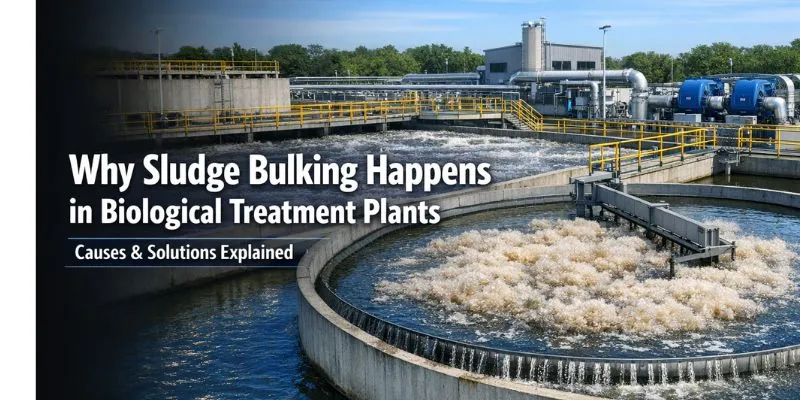
Wastewater plant operators know this problem too well. Everything appears normal in the aeration tank — MLSS levels seem stable, blowers are running, and the biological system appears active — yet the secondary clarifier suddenly stops performing properly. Sludge does not settle, the sludge blanket rises, and effluent TSS begins exceeding discharge limits. This condition is commonly known in the wastewater industry as sludge bulking.
It is not a rare malfunction. Activated sludge systems worldwide experience this issue periodically, especially in municipal STPs and industrial ETPs where influent characteristics fluctuate. Biological treatment depends on microorganisms behaving in a specific balance. When that balance shifts, settling properties collapse quickly.
From an operational perspective this is critical because the secondary clarifier acts as the final solid-liquid separation barrier. When sludge bulking occurs, treated water quality deteriorates and plants risk violating discharge standards set by regulators such as CPCB (India), USEPA, and the EU Water Framework Directive.
Understanding what actually happens inside the biology helps operators diagnose and control the problem early.
What Sludge Bulking Actually Means
In an activated sludge process, microorganisms form compact flocs. These flocs settle efficiently in the secondary clarifier, allowing clear treated water to overflow.
However, under certain conditions microorganisms grow differently. Instead of compact flocs, filamentous bacteria begin dominating the biomass. These organisms grow in long thread-like structures that interfere with floc formation.
When filamentous growth becomes excessive:
- Flocs become loose and fluffy
- Sludge density decreases
- Settling velocity drops drastically
- Clarifier sludge blanket expands
The operational result is a high Sludge Volume Index (SVI).
Typical reference values used in wastewater plant operation:
| Parameter | Typical Range |
|---|---|
| Normal settling sludge | 80 – 120 mL/g |
| Bulking begins | >150 mL/g |
| Severe bulking | >200 mL/g |
When SVI crosses these limits, sludge settling performance declines sharply, directly affecting secondary clarification — a critical stage in biological treatment plants.
Real Plant Conditions That Trigger Sludge Bulking
While filamentous bacteria are the direct cause, several operational conditions trigger their growth. In real wastewater treatment plants these factors usually occur in combination.
1️⃣ Low Dissolved Oxygen (DO)
Filamentous organisms thrive under low oxygen conditions. Maintaining adequate aeration is therefore essential.
Typical DO recommendations in aeration tanks:
- 2–3 mg/L for conventional activated sludge
- Minimum 1.5 mg/L to prevent filament dominance
When DO drops below these levels:
- Filamentous bacteria outcompete floc-forming bacteria
- Sludge structure weakens
Common operational causes of low DO:
- Blower failure or insufficient aeration capacity
- Excess MLSS loading
- Diffuser clogging
- Poor air distribution
2️⃣ High F/M Ratio (Food to Microorganism Ratio)
When organic loading increases suddenly, microorganisms grow rapidly but floc structure does not mature properly.
Typical F/M ratio for conventional activated sludge:
0.2 – 0.5 kg BOD / kg MLSS / day
Higher values encourage dispersed bacterial growth and poor floc formation, often leading to bulking.
This situation is frequently observed in:
- Food processing industries
- Dairy wastewater treatment plants
- Seasonal industrial discharges
3️⃣ Nutrient Deficiency
Microbial growth requires balanced nutrients. Biological treatment systems typically follow this nutrient ratio:
BOD : Nitrogen : Phosphorus = 100 : 5 : 1
If nitrogen or phosphorus becomes limiting:
- Filamentous bacteria dominate
- Floc-forming organisms weaken
This condition is common in industrial wastewater where organic carbon is high but nutrients are insufficient.
4️⃣ Low pH or Toxic Shock Loads
Biological systems are sensitive to sudden chemical changes.
Optimal pH range: 6.5 – 8.5
If influent wastewater contains:
- Heavy metals
- Toxic solvents
- Strong acids or alkalis
the microbial population shifts, often allowing filamentous bacteria to dominate.
Equalization tanks are typically designed to prevent these shock loads from reaching the biological reactor.
5️⃣ Excess Sludge Age (High SRT)
Sludge age or Solids Retention Time (SRT) strongly influences microbial ecology.
| Process Type | Typical SRT |
|---|---|
| Conventional activated sludge | 5 – 10 days |
| Extended aeration | 20 – 30 days |
When sludge becomes too old:
- Slow-growing filamentous bacteria dominate
- Floc strength deteriorates
Operators sometimes avoid sludge wasting, which increases MLSS and SRT — eventually leading to bulking.
6️⃣ Poor Mixing in Aeration Tanks
Poor mixing creates dead zones where oxygen distribution becomes uneven. These localized anaerobic pockets favor filamentous growth.
Common design or operational causes include:
- Improper diffuser layout
- Undersized mixers
- Channeling within aeration tanks
Most Common Filamentous Bacteria Responsible
Operators often identify filamentous organisms through microscopic analysis of activated sludge samples.
| Organism | Typical Cause |
|---|---|
| Sphaerotilus natans | Low dissolved oxygen |
| Microthrix parvicella | Low F/M ratio |
| Thiothrix | Sulfide presence |
| Nocardia | High grease and oil |
Microscopic observation remains one of the most reliable diagnostic tools used in wastewater treatment plant operation.
Practical Plant-Level Indicators
Before bulking becomes severe, operators usually observe several warning signs:
- Increasing SVI values
- Rising sludge blanket in clarifier
- Higher effluent turbidity
- Floating sludge
- Foaming in aeration tanks
If ignored, these conditions can eventually lead to clarifier washout.
Sludge Bulking in Indian STPs and ETPs
Wastewater treatment plants across India frequently encounter sludge bulking due to:
- Highly variable wastewater loads
- Inadequate equalization tank capacity
- Power interruptions affecting aeration
- Nutrient imbalance in industrial effluents
Regulators such as the Central Pollution Control Board (CPCB) enforce discharge standards that plants must meet consistently.
| Parameter | Typical CPCB Limit |
|---|---|
| BOD | 30 mg/L |
| TSS | 50 mg/L |
| COD | 250 mg/L |
Bulking events often push plants beyond these limits, creating regulatory compliance risks.
FAQ: Sludge Bulking in Biological Treatment
1. What is the main cause of sludge bulking in activated sludge systems?
The most common cause is excessive growth of filamentous bacteria, typically triggered by low dissolved oxygen, nutrient deficiency, or sudden increases in organic loading.
2. What is the acceptable SVI range in wastewater treatment plants?
Operational guidelines commonly referenced by organizations such as AWWA and USEPA recommend an SVI between 80–120 mL/g for good sludge settling performance.
3. Why does low dissolved oxygen promote sludge bulking?
Filamentous bacteria can survive under oxygen-limited conditions better than floc-forming bacteria. When DO drops, filaments gain competitive advantage.
4. Can industrial wastewater increase bulking risk?
Yes. Industrial effluents often contain toxic compounds, nutrient imbalances, or fluctuating loads that disturb microbial equilibrium and encourage filament growth.
5. How can operators detect sludge bulking early?
- SVI monitoring
- Microscopic sludge analysis
- 30-minute settling tests
- Clarifier sludge blanket measurement
Industry Note
Biological wastewater treatment behaves more like a living ecosystem than a mechanical system. Sludge bulking illustrates this clearly — aeration levels, nutrient balance, organic loading, and sludge age interact continuously.
Facilities that maintain proper equalization, stable aeration control, and disciplined sludge wasting typically avoid severe bulking problems. Plants that ignore these fundamentals often face recurring operational instability.
From practical experience across wastewater installations, the stability of biological treatment systems depends less on technology and more on consistent process control — an operational philosophy that Plizma Technology emphasizes while supporting performance optimization and troubleshooting in modern ETP and STP facilities.
RECENT BLOG
Difference Between Softener, RO, and DM Plant
2026-02-25
Zero Liquid Discharge (ZLD) – Is It Becoming Mandatory?
2026-02-20

Top 10 Water And Wastewater Treatmant Plant Manufacturer in Eastern India
2026-02-12

What Is an Effluent Treatment Plant (ETP)? A Complete Guide
2026-02-10