


2026-04-06



2026-02-20 | by Joydip Manna
In last few years, we at Plizma Technology seeing one pattern very clearly. Industries not asking whether to treat wastewater, that part already clear. Now question becoming — is Zero Liquid Discharge compulsory? Is it regulatory pressure or just environmental trend?
Short answer: in many sectors, yes it is moving toward mandatory, but not universally across all industries and locations. Situation is technical and regulatory both, and little confusing on ground.
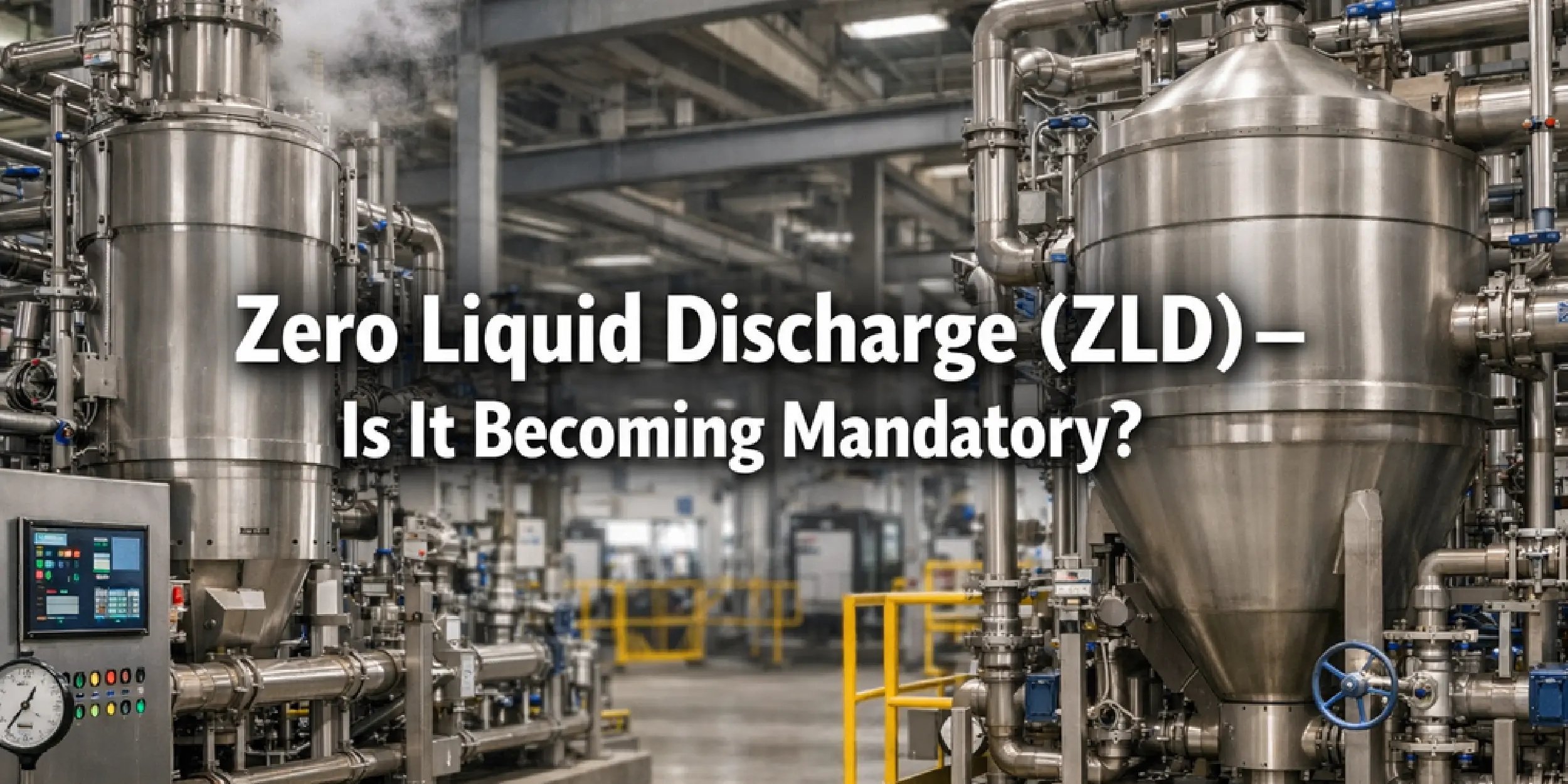
Zero Liquid Discharge (ZLD) is an advanced wastewater management approach where no liquid effluent leaves the industrial boundary. Entire wastewater is treated, recovered, and recycled. Only solid waste (salts, sludge) remains for disposal.
Technically ZLD includes:
Final discharge: zero liquid. Only solids.
ZLD is not just high-end ETP. It is resource recovery + regulatory shield.
In India especially, groundwater depletion and river contamination forced stricter norms. Regulatory bodies like:
have tightened discharge standards under:
For certain industries, ZLD is not optional anymore.
In several sectors — already mandatory.
India entering severe water stress zones (NITI Aayog reports repeatedly). Industrial abstraction limits tightening. Reuse becoming survival issue.
ZLD recovers 90–95% water internally.
BOD, COD, TDS limits tightening under CPCB guidelines.
High TDS effluent cannot be biologically treated. Only evaporation-based ZLD solves that permanently.
Export-oriented companies must align with ISO 14001, EU environmental directives, and corporate ESG scoring norms.
ZLD gives strong ESG positioning. This is reality at board level discussions.
No.
Requirement depends on:
No blanket rule for all industries.
Under United States Environmental Protection Agency (USEPA), ZLD not universally mandatory. But specific sectors under ELG face tight discharge norms pushing toward evaporation systems.
EU Water Framework Directive pushing zero pollution goal, but ZLD not blanket rule.
In water-scarce regions, ZLD increasingly preferred due to reuse economics.
Globally trend is upward, but sector-based.
CAPEX:
OPEX Challenges:
Many plants fail not due to regulation, but poor design or improper O&M planning.
Move toward ZLD if:
Avoid blind installation if:
Engineering decision must be data-driven.
Water recovery up to 95–98% possible in optimized systems.
| Factor | ZLD Advantage | ZLD Challenge |
|---|---|---|
| Compliance | Near-zero discharge risk | High CAPEX |
| Water Reuse | 90–95% recovery | Energy intensive |
| ESG Rating | Strong improvement | Skilled O&M required |
| Long-Term Risk | Reduced regulatory shutdown | Salt disposal complexity |
CPCB mandates ZLD for specific high-pollution industries like textile dyeing, tannery, distillery, and certain pharma clusters. Not blanket for all industries.
MoEFCC does not universally mandate ZLD. Environmental Clearance conditions may require it based on pollution load and location.
Typically 90–95%. Advanced systems may reach 98% with higher OPEX.
For water-scarce regions and high TDS effluent industries — yes long-term viable. For low-pollution industries, conventional ETP may be sufficient.
Zero Liquid Discharge is not hype anymore. It is moving from optional environmental strategy to regulatory expectation in multiple sectors. Not universal mandate yet, but direction is clear.
Decision must be engineering-based, regulator-aligned, and financially calculated — not panic-driven.
At Plizma Technology, we see this shift happening plant by plant. The question is not “if” in many sectors, it is “when”.
Industries that prepare early design properly. Those that delay often forced under compliance deadlines, which becomes costlier.
Time window still there. But narrowing.
👉 Also read:
What Is an Effluent Treatment Plant (ETP)? A Complete Guide
Contact:
Click Here
Last updated on: 2026-02-20
2026-04-06
2026-03-24