
2026-09-28



2026-03-30 | by Joydip Manna

Faecal Sludge Treatment Plant (FSTP) sounds simple when explained in presentation, but on actual site it is rarely simple. On drawing, arrows move properly, detention time looks stable, sludge behaves like assumed. In field, none of that stays neat for long. Tankers do not come uniformly. Sludge does not come with fixed strength. Operators do not receive ideal feed, they receive thick, black, septic, grit-heavy, plastic-mixed mass that already sat for months or years inside septic tanks and pits.
This is the first thing many people miss. An FSTP is not a small STP. It is a completely different operating reality. In India and across many South Asian towns, sanitation is still largely based on onsite containment systems. That means septic tanks, single pits, twin pits, holding tanks, informal containment chambers, and badly designed underground structures all become sources of desludged material. What reaches the plant is not fresh sewage. It is aged septage or faecal sludge, already anaerobic, already partially stabilized in some cases, and in many cases mixed with greywater, grit, rags, oil, detergent, and non-faecal waste also.
Because of this, most FSTP failures do not begin with technology only. They begin with wrong assumptions. Wrong assumption on inflow. Wrong assumption on moisture loss. Wrong assumption on operator response. Wrong assumption on weather. And after that, plant starts underperforming slowly, not dramatically. This is why many systems appear commissioned, but not really functioning the way design report promised.
So this article is not about ideal theory only. It is about how FSTP actually works under municipal pressure, tanker irregularity, monsoon, odour complaints, overloaded drying beds, and human mistakes that happen more often than reports admit.
FSTP stands for Faecal Sludge Treatment Plant. It is a treatment facility developed for handling faecal sludge and septage removed from onsite sanitation systems such as septic tanks, pit latrines, and other containment structures. Under India’s Faecal Sludge and Septage Management approach, this kind of plant is critical because sewer networks still do not cover most settlements fully.
The reason FSTP became important is very direct. Toilet construction increased faster than treatment infrastructure. So waste was being stored somewhere, but not always treated somewhere. Desludging trucks often had no legal disposal point. Once that happens, discharge into drains, open land, low-lying areas, riverbanks, and abandoned plots starts becoming normal practice. This is exactly the sanitation chain break that FSTPs are meant to close.
And this is not minor issue. Untreated faecal sludge carries pathogens, high organic load, nutrients, suspended matter, and contamination risk to both groundwater and surface water. Where containment is poor, or illegal discharge is common, local health burden rises quietly. Water bodies suffer first, then neighbourhoods, then downstream users. The problem spreads before it is seen.
One of the most damaging misunderstandings in project planning is treating FSTP like a smaller version of a sewage treatment plant. It is not. Sewage treatment plants generally receive continuous, more diluted wastewater flow. FSTPs receive batch discharge, highly variable solids, thicker organics, and unpredictable loading pattern.
An STP depends heavily on hydraulic regularity and relatively stable biological conditions. An FSTP, on the other hand, must survive shock, pause, inconsistency, and solids-heavy loading. In STP design, average flow often makes sense as a planning basis. In FSTP design, variability matters more than average. Two days may pass with low loading, then suddenly ten tankers arrive in a few hours because of local contractor routing or municipal enforcement drive.
That means if someone designs an FSTP with STP mindset, performance problems begin early. Pumping becomes unstable. Bed loading becomes poor. Retention time collapses. Odour increases. Biological treatment downstream loses balance. Then people say the technology failed, while in truth, the operating assumptions failed first.
Incoming sludge at an FSTP can vary massively depending on source, desludging frequency, tank condition, groundwater intrusion, and tanker practice. Some loads are thick and almost scoopable. Some are diluted because operators added water for pumping ease. Some are mixed with sand because tanks are damaged. Some include cloth pieces, sanitary waste, gutkha sachets, stones, plastic bags, and even construction debris. This is one reason why front-end handling matters more than many municipalities expect.
Common characteristics of incoming faecal sludge include:
Once again, the plant is not processing a clean, predictable influent. It is processing what the sanitation system actually sends, not what planners wanted it to send.
This is the first operational stress point. Tankers arrive and discharge into a receiving station, often with screening and grit separation provided before or during transfer to the next stage. In reports this sounds routine, but receiving area is where many plants first start losing control.
If screening is weak or bypassed, plastics and cloth quickly choke channels, valves, pumps, and transfer lines. If grit removal is inadequate, heavy solids accumulate in chambers and reduce usable volume. If unloading is unmanaged, too many tankers discharge close together and everything downstream experiences hydraulic shock.
The receiving zone also matters from public interface point of view. Odour complaints usually start here. If the platform is exposed, if drainage is poor, or if washdown water stagnates, the entire plant gets local resistance very fast. In many towns, one badly managed unloading area is enough to turn the whole community against the facility.
After initial receiving, one of the most important functions is to separate solid fraction from liquid fraction. This is commonly done using sludge drying beds, planted drying beds, geobags in some cases, or mechanical dewatering where budgets and O&M capacity allow. In smaller and medium Indian FSTPs, sludge drying beds and planted beds are still common because they are simpler, lower energy, and easier to maintain in theory.
But theory and field are again different. Drying beds work properly only when loading rate, resting cycle, drainage condition, and weather are all respected. If beds are continuously loaded without rest, the sludge layer stays wet. If rainwater enters, drying collapses. If underdrain system is blocked, waterlogging starts. If desludging volume exceeds design basis for several weeks, capacity effectively falls even if the physical bed area remains unchanged.
This is why drying bed design should never ignore:
In dry regions, beds can be quite forgiving. In humid and monsoon-prone regions, they are much more sensitive. Eastern India, coastal belts, and high-rainfall areas often show slow drying, sludge backlog, insect nuisance, and odour persistence if beds are not protected or properly rotated.
The liquid draining out from drying beds or separation stage usually carries dissolved organics, nutrients, pathogens, and residual suspended solids. This fraction goes to secondary treatment, commonly through anaerobic baffled reactors (ABR), settling chambers, baffled tanks, filter media systems, or constructed wetlands. These systems are chosen because they are relatively low energy and suitable for decentralized conditions.
Still, these units also have real limits. If tanker discharge becomes too concentrated over short duration, hydraulic retention time drops. If solids carryover is high, baffled units and wetlands begin underperforming. If operators do not manage flows properly, short-circuiting occurs. When this happens, effluent quality may look acceptable one day and poor on another day, confusing municipalities that expect steady results.
Constructed wetlands are especially useful where land is available and the community can support passive systems. But wetland performance also depends on pretreatment quality, bed condition, hydraulic distribution, plant health, and prevention of clogging. Wetlands are not magic landscape units. If solids loading is excessive, they turn into maintenance burden.
The final treated effluent may undergo disinfection, commonly chlorination, before discharge or reuse. This step is often underestimated. Chlorine dosing is only useful when contact time, dose control, and residual monitoring are properly maintained. Otherwise, plants claim disinfection without proving it.
Common mistakes include underdosing, irregular chemical preparation, no residual testing, and operator assumption that “some chlorine smell” means system is fine. It does not. Where treated water is reused or discharged near sensitive receptors, disinfection reliability matters greatly.
The dried sludge coming from beds can potentially be reused as soil conditioner, co-compost feedstock, or processed for resource recovery depending on pathogen reduction, stabilization, and local regulatory acceptance. This is where FSTP can move beyond disposal logic and enter resource logic.
But here also, reality matters. Sludge is not reusable only because it dried. If drying is incomplete, if contamination remains high, or if non-faecal waste is mixed in, reuse becomes risky or unacceptable. Quality control is often weak in smaller towns, and that is one reason some reuse programs fail even though the concept is technically strong.
Let us imagine a realistic municipal scenario, built from repeated field learnings seen across many small and mid-sized Indian towns.
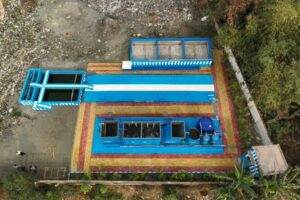
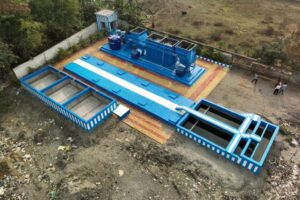
A town in central India commissions an FSTP of about 20 KLD. The layout is sensible on paper: receiving tank, manual screen, grit chamber, drying beds, anaerobic baffled reactor, planted wetland, chlorination chamber. Civil work is completed. Trial run looks acceptable. Officials visit. Photos are taken. The plant is called successful before it has really faced actual operating conditions.
In the first two weeks, sludge inflow stays low because private tanker operators are still not fully diverted to the site. Then local administration issues a stricter disposal order. Suddenly, within a month, all desludging trucks begin coming to the FSTP, but without route scheduling.
Now the real problems start.
On some mornings, five or six tankers arrive within ninety minutes. All unload almost back-to-back. The receiving screen clogs because one load contains cloth and plastic waste. The operator, already under pressure from waiting drivers, partially bypasses screening just to keep movement going. Grit begins entering downstream chambers. One drying bed, still not sufficiently rested from previous load, is used again because the other bed has ponded water from overnight rain.
By week six, the beds remain wetter for longer than expected. Sludge scraping becomes difficult. Workers delay removal because manual handling is unpleasant and no clear rotation chart was given. Meanwhile, the liquid fraction from overloaded beds carries more suspended matter into the ABR than anticipated. The ABR does not “break” in one dramatic event. It simply starts receiving more shock than it was meant to absorb.
Two more things happen quietly. First, one valve is repeatedly left in wrong position after washdown. Second, chlorination becomes symbolic rather than controlled because the operator is busy with unloading area management. Residual chlorine is not checked. Nearby residents start complaining about smell around noon, especially on hotter days. Municipal staff at first say odour is temporary.
But odour is not temporary now. It becomes a signal. A sign that resting time, solids handling, receiving discipline, and flow control are already slipping.
By the third month, the plant still “looks operational” to an outside visitor. Water is moving. Trucks are unloading. Beds contain sludge. Wetland is green enough from a distance. But performance data begins showing inconsistency. Effluent occasionally approaches acceptable limits, and on shock days it drifts away from them. Sludge backlog starts reducing true capacity. Local complaints increase. Operators feel blamed, though they never received practical training for this level of irregular loading.
What corrected the situation was not a new expensive technology package. It was operational repair.
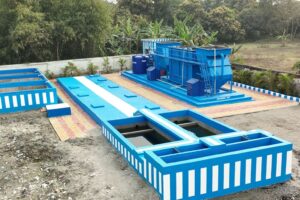
After these changes, odour reduced, drying improved, and effluent quality stabilized much closer to target. Not perfect every day, no plant is, but much more reliable. This is the key lesson: in many FSTPs, design is not the first thing failing. Operations are failing because design was never translated into real field discipline.
Unlike sewered systems, FSTPs do not receive stable hourly loading. Tanker arrivals are influenced by contractor behavior, fuel economics, municipal enforcement, distance, and customer demand. This makes the plant inherently batch-loaded. If there is no regulated desludging program, the plant keeps shifting between underuse and overload.
Monsoon does not care about detention time calculations. If drying beds are exposed and drainage is poor, solids handling gets delayed. In humid zones, sludge remains wet longer, creating backlog. In some plants, one rainy season effectively cuts the available solids treatment capacity by a major fraction.
A simple plant is not the same as an operator-proof plant. FSTPs depend heavily on correct manual action: gate operation, bed switching, cleaning, sludge removal timing, dosing, and record-keeping. One wrong practice repeated daily becomes a plant-wide performance issue in a month.
Odour is not only nuisance, it is a social risk. Many technically acceptable FSTPs face public resistance because odour control was ignored. Open unloading, stagnant drains, exposed screenings, wet sludge stockpiles, and poor washdown all contribute. Once neighbourhood trust is lost, even good operational improvements become harder to defend.
A lot of incoming sludge does not come from well-designed septic tanks built to code. It comes from undersized chambers, broken tanks, makeshift pits, structures with no outlet baffle, or tanks never desludged in years. So the incoming waste quality can be far more extreme than guideline assumptions.
For India, FSTP planning and operation should not be looked at in isolation. It sits inside a broader sanitation and environmental framework that includes faecal sludge and septage management policy, local urban body responsibilities, discharge standards, reuse expectations, and public health protection. BIS standards for septic tank design, CPCB guidance , and MoHUA sanitation frameworks all matter because the plant is only one link in the sanitation chain.
WHO reuse thinking also becomes relevant where treated sludge or treated effluent is intended for agricultural or landscaping application. A plant that treats partially but markets output as safe without validation creates future liability, not circular economy.
For a broader visual understanding of wastewater and sludge treatment realities, this video can be placed here within the article flow:
Plants usually improve not when they become more complicated, but when they become more honest about field conditions. A workable FSTP usually has some common strengths:
This sounds ordinary, but that is exactly the point. Most performance gains come from ordinary discipline done continuously. Not from one-time inauguration quality.
There is no universal best FSTP configuration. Every choice brings trade-offs.
The right system is the one that matches local sludge behaviour, tanker logistics, climate, municipal discipline, and operator capacity. Template copying from one state to another often causes trouble because the same design behaves very differently under different inflow and weather patterns.
No. An FSTP handles faecal sludge or septage from onsite sanitation systems, which is much more concentrated and irregular than sewage. CPCB and urban sanitation frameworks recognize that septage management needs separate handling logic because inflow is batch-based and solids-rich.
Because odour is often more related to operation than drawing approval. Poor unloading control, stagnant drains, overloaded beds, exposed screenings, and untreated wet sludge all contribute. Regulatory compliance on paper does not automatically mean acceptable neighbourhood conditions.
Potentially yes, but only after adequate treatment, stabilization, and quality validation. WHO-oriented reuse thinking and local regulatory guidance matter here. Dry appearance alone does not confirm pathogen safety or suitability for land application.
Because rainfall, humidity, drainage, and bed resting cycles were underestimated. In many cases the bed design is not the only issue, the operational loading pattern is also unrealistic. Once beds remain wet too long, true solids-handling capacity drops quickly.
In many cases, it is not a core technology fault. It is mismatch between design assumptions and municipal operating reality. Irregular tanker inflow, wrong valve handling, poor screening maintenance, and lack of bed rotation are repeated causes seen in practice.
No. In fact, FSTPs are especially relevant where sewer coverage is limited and onsite containment dominates. That is exactly why many Indian towns moved toward faecal sludge and septage management under decentralized sanitation planning.
A Fecal Sludge Treatment Plant (FSTP) is a facility designed to receive, treat, and safely manage sludge collected from on-site sanitation systems like septic tanks, protecting the environment from contamination. It treats waste using solid-liquid separation, anaerobic digestion, and drying to produce safe, usable manure and clean, dischargeable water.
How FSTP Works: Key Treatment Stages
Collection and Screening: Desludging trucks bring sewage to the plant, where it passes through a screen/grit chamber to remove large solids and grit.
Solid-Liquid Separation: The sludge settles in tanks or reactors, separating solids from liquid components.
Solid Treatment (Stabilization & Composting): Solid sludge goes to drying beds (or solar dryers) to remove moisture. The dried sludge is then mixed with organic waste and co-composted to create nutrient-rich fertilizer.
Liquid Treatment (Decalification): The liquid (supernatant) passes through an Anaerobic Baffled Reactor (ABR) and gravel filters to remove organic matter, followed by polishing ponds for final polishing.
Disinfection: The treated liquid is treated with chlorination or UV light to eliminate remaining pathogens before safe disposal.
Environment and Health: Prevents the dumping of untreated sewage into water bodies, protecting public health from diseases.
Resource Recovery: Produces agricultural compost and treats wastewater for non-potable reuse.
Sustainability: Provides a decentralized, cost-effective sanitation solution compared to vast, expensive sewer networks
FSTP is not difficult because equations are difficult. It becomes difficult because sanitation systems in real towns are messy, informal, and inconsistent. The plant receives the truth of the city, not the neatness of the DPR. That is why successful operation depends on accepting variability as the central design condition.
From repeated field observations and engineering review perspective, including the kind of operating situations typically examined by Plizma Technology, the best-performing FSTPs are not always the most advanced ones. They are the ones where design, loading pattern, operator action, and local climate are made to work together with some honesty. Once that alignment happens, performance improves. When it is ignored, failure comes slowly, quietly, and then all at once.
LAST UPDATED : 31-3-2026
2026-09-28
2026-09-23