


2026-09-28



2026-04-26 | by Joydip Manna
(Plizma Technology — this unit is often underestimated during design, but later becomes a major reason for operational issues)
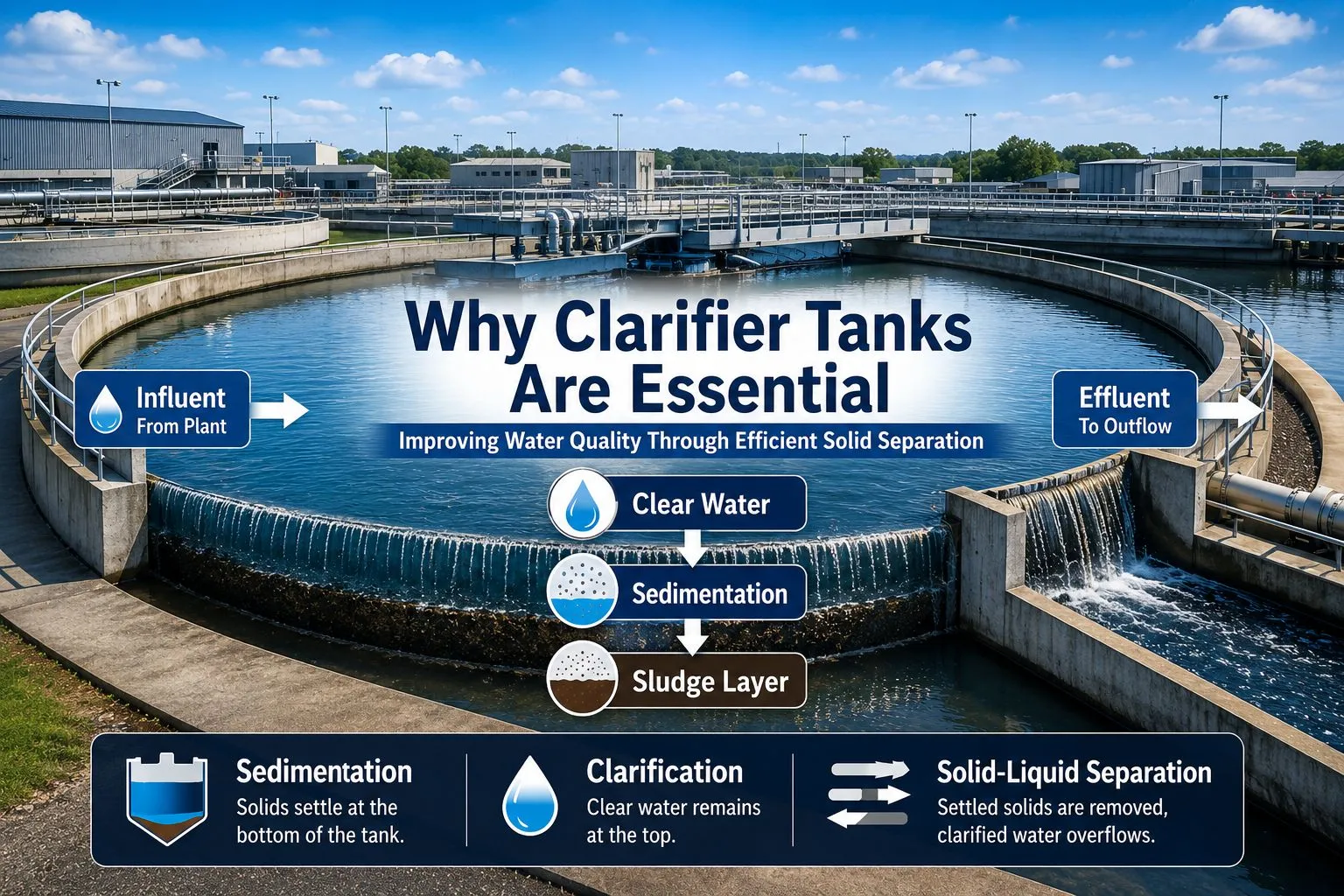
Clarifier tank looks simple on paper — just a gravity unit. But in actual plant operation, this is the stage where the process either stabilizes or starts failing slowly.
Most treatment systems — whether designed to meet CPCB norms, BIS IS 10500, or WHO guidelines — depend heavily on suspended solids removal before filtration and disinfection.
If clarification is weak, downstream units are forced to overperform. This leads to higher chemical consumption, frequent downtime, and operational instability.
Raw water is never constant. In India especially:
Operators continuously adjust dosing — increase alum, reduce, then increase again. Filters choke, sludge builds up, pumps get affected.
The problem is not always chemical dosing. Often, the clarification stage is not performing as required.
A clarifier is a sedimentation unit designed to separate suspended solids after coagulation–flocculation using gravity settling.
From a design and regulatory perspective:
Typical internal zones:
Clarifier allows proper settling of flocs formed during coagulation.
If detention time is maintained (typically 2–4 hours):
Without this:
Typical performance: 60–80% TSS removal
Clarifier reduces load on:
Result:
Clarifier removes:
This improves turbidity before filtration and enhances disinfection efficiency.
As per WHO guidance, microorganisms can attach to particles — if not removed, chlorination or UV becomes less effective.
Coagulants like alum, PAC, and polymers require proper settling conditions.
Without clarifier:
With proper clarification:
Clarifier collects sludge in a defined zone.
Without proper sludge handling:
With proper removal:
Although clarifier adds initial cost, it reduces:
It also minimizes:
Skipping proper clarification often results in higher long-term cost.
In regions like India, Bangladesh, and the Middle East:
Clarifier becomes essential for process stability.
To meet CPCB discharge standards and BIS potable water limits, consistent clarification performance is critical.
Lamella clarifiers reduce footprint but require tighter operational control.
Q1. Is clarifier mandatory as per CPCB?
Not directly specified, but achieving TSS limits without it is difficult in most cases.
Q2. Can filters replace clarifier?
No. Filters are polishing units, not designed for bulk solids removal.
Q3. Ideal turbidity after clarifier?
Typically below 10–20 NTU before filtration.
Q4. Does clarifier reduce BOD/COD?
Partially — around 20–40% reduction due to removal of settleable organics.
Q5. What happens if sludge is not removed?
It re-suspends and causes sudden turbidity spikes.
Clarifier tank looks simple — but it is the control point of the entire treatment chain.
Most downstream failures — membrane fouling, chemical overuse, filter choking — often originate from poor clarification.
At Plizma Technology, many system corrections start from this stage. Not because other units are weak, but because this one is often ignored during design and operation.
Small neglect here leads to large operational cost later — a pattern seen repeatedly in real plants.
If your system isn’t delivering consistent results, it’s time to act,
Contact our team
2026-09-28

2026-09-23