
2026-09-28



2026-05-18 | by Joydip Manna
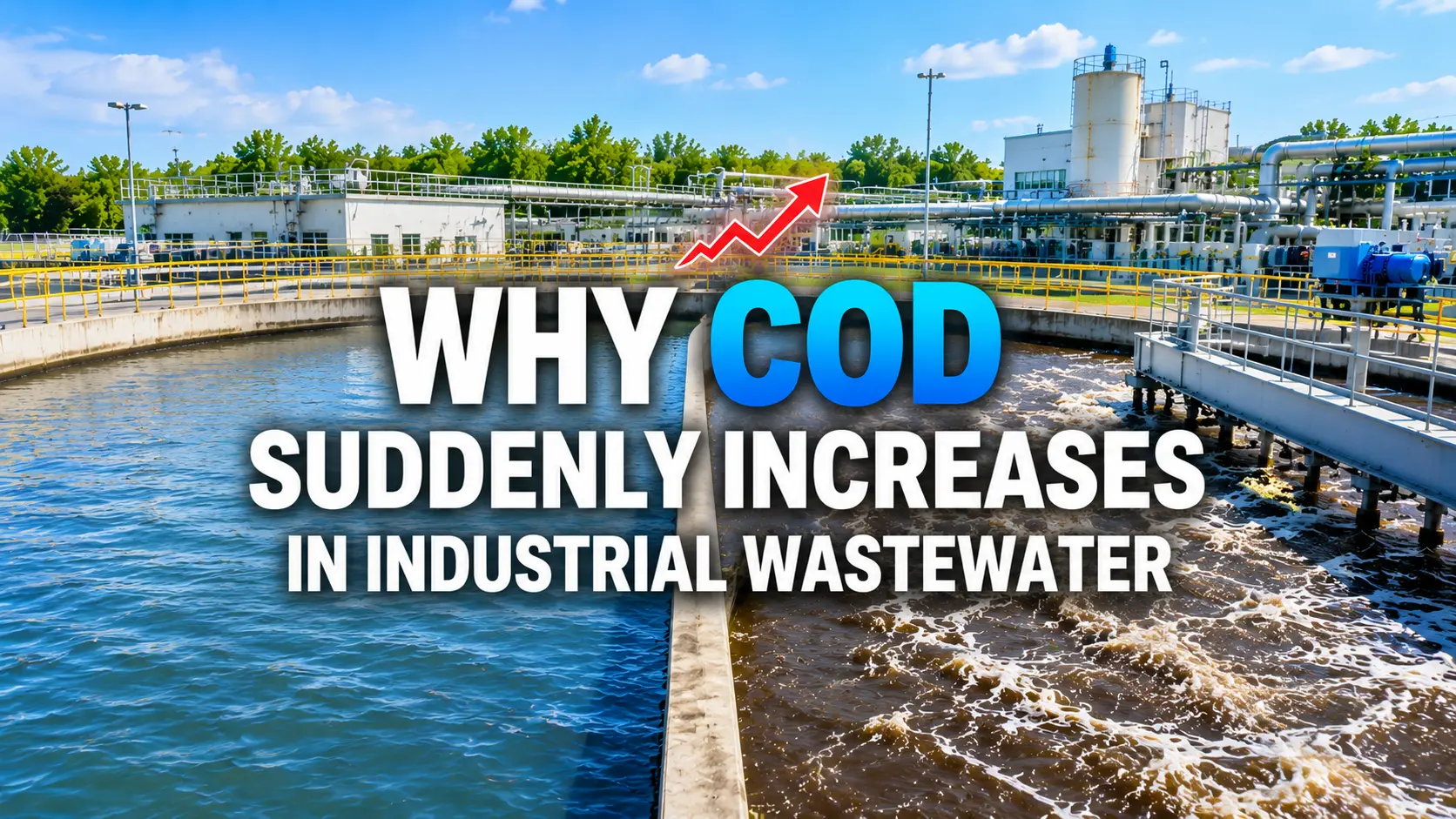
COD increases suddenly in industrial wastewater due to shock loads, batch discharges, toxic chemical entry, aeration failures, poor equalization, incorrect chemical dosing, or biological treatment disturbances. These factors either increase the organic load entering the treatment system or reduce the plant’s ability to remove pollutants effectively, resulting in a rapid rise in COD levels. Proper equalization, stable biological treatment, controlled chemical dosing, and continuous monitoring are essential to maintain consistent COD removal and prevent compliance issues.
That’s why COD is a dangerous indicator. It reacts fast. Much faster than BOD.
As per Central Pollution Control Board limits, COD needs to stay controlled (around 250 mg/L for inland discharge in many cases). When it shoots up, it’s not just a compliance problem… it means the system somewhere is not holding properly.
Design says steady flow, steady load. Real plant never behaves like that.
Some days high production, some days low. Cleaning water suddenly comes. Sometimes chemical wash gets dumped without timing. Operators adjust based on experience, not always data. Equalization tank may be there, but not really doing full job.
So system keeps running… looks stable… then one day COD jumps and everyone starts checking lab report first.
This is where it usually starts.
Batch discharge, tank cleaning, CIP water, solvent wash… all this comes with very high COD. If it enters all at once, system cannot handle immediately.
If equalization tank is working, it spreads this load. But if not, full shock directly goes into biological tank. Then biology struggles, and COD shows it immediately.
Very common situation.
Tank is installed, but mixing not proper. Either mixer not working, aeration blocked, or flow pattern wrong. Instead of holding and balancing, water just passes through.
Design says it should give several hours buffer… but in operation, it behaves like a normal tank.
Then whatever fluctuation comes, it goes straight ahead. Biology gets uneven load, COD starts fluctuating, then rising.
Biological system is strong, but also sensitive.
If toxic things enter—like heavy metals, high salt, solvents, or even sudden pH change—microorganisms get affected. Sometimes they don’t die immediately, but activity drops.
You’ll see signs slowly. Sludge becomes darker, settling not proper, maybe slight smell change. But operators often miss early signs.
Then COD starts increasing because organic matter is not getting broken down fully.
Even short aeration issue creates problems.
Blower trips, diffuser chokes, power fluctuation… oxygen level drops. Without oxygen, microbes slow down.
System may still look running, but treatment not happening fully. Next sampling, COD increases.
Primary treatment is often underestimated.
If coagulation and flocculation not working properly—due to wrong dosing or pH not maintained—then suspended load goes forward.
Biological stage then gets extra load, and slowly loses efficiency.
Operators sometimes keep same dosing for weeks… but influent changes daily. That mismatch creates issues.
Not always a process issue.
Sometimes raw water is mixing with treated water somewhere. Valve leakage, overflow, wrong line connection… small things.
Plant looks normal, but outlet COD suddenly high . These are tricky to find because nothing “looks broken”.
Sludge is not waste, it is an active system part.
If sludge not removed properly, or return sludge not controlled, system loses balance. Biomass becomes either too old or too less.
Then efficiency drops. Not immediately… but slowly. Then one day COD spikes.
Before panic, always recheck.
COD test can go wrong. Chloride interference, digestion issue, sampling error… all possible.
So one sudden reading should always be confirmed. But if trend continues, then definitely a process issue.
COD includes everything oxidizable, not just biodegradable.
So if wastewater has dyes, pharma compounds, complex chemicals… they won’t degrade easily.
In that case, plant may be working properly, but COD still high. That’s why COD and BOD both need to be seen together.
When COD increases, don’t overthink, just check basics step by step.
Most of the time, issue is found somewhere here only.
Why COD suddenly increases even when plant looks normal?
Because internal imbalance already exists. Equalization weak, biology stressed… then one load comes and COD reflects it immediately.
Can COD increase without BOD changing?
Yes. COD includes non-biodegradable matter, so BOD may stay same while COD increases.
Is high COD always plant failure?
No. Sometimes influent itself is high, or contains refractory compounds. Need to compare inlet and outlet.
How fast can COD increase?
Very fast. In batch industries, within hours… sometimes even less.
Which part of plant affects COD most?
Biological stage. If that gets disturbed, COD increase becomes visible quickly.
COD spikes are not random events—they are usually the result of small operational gaps building up over time. In many cases, equalization is not properly managed, chemical dosing is not adjusted as per load variation, and sludge control is overlooked.
Then, when even a slightly higher load enters the system, the plant is unable to absorb the shock… and COD levels suddenly rise.
At Plizma Technology, field experience across multiple industrial ETPs shows a consistent pattern. COD fluctuations are rarely caused by a single issue. Instead, they occur due to a combination of influent variation and operational inefficiencies.
When both aspects—load management and process control—are addressed together, the system stabilizes. If ignored, COD spikes continue to repeat, affecting compliance and overall plant performance.
Also Read :
Necessity of ETPs in Pharma, Textile, and Chemical Industries
2026-09-28
2026-09-23