

2026-09-23
Water Treatment
Five major challenges and trends impacting the water industry
2024-05-08 | by Joydip Manna
The Changing Landscape of the Water Industry
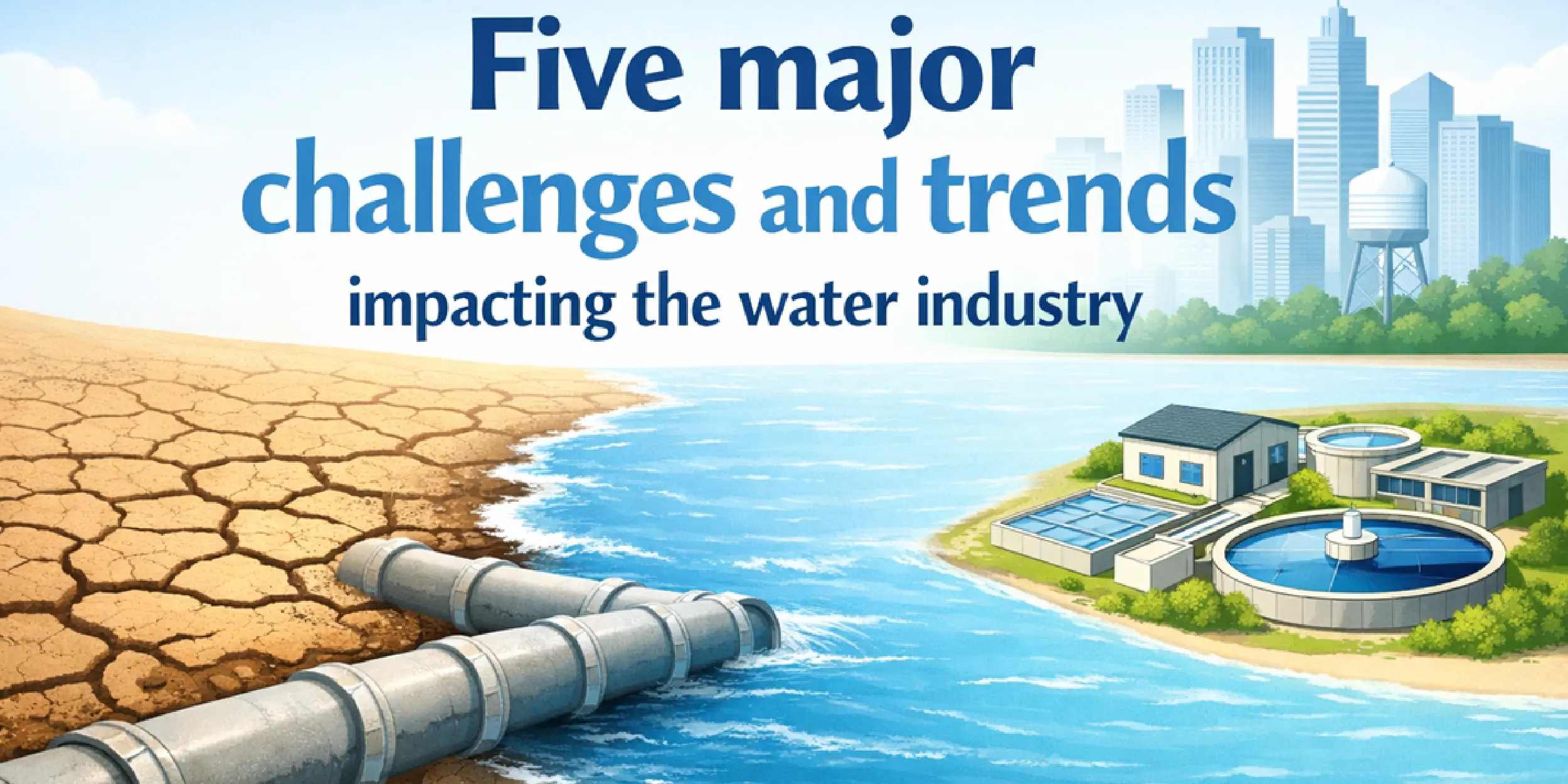
The water industry is no longer the slow, predictable utility sector it once was. Today cities, industries, and infrastructure operators are dealing with a combination of problems—water scarcity, tougher regulations, aging assets, and a lack of skilled operators. These issues are deeply connected, and fixing one often exposes another.
Five Major Challenges and Trends Impacting the Water Industry
1. Increasing Water Scarcity and Uncertain Supply
Water availability can no longer be taken for granted. Groundwater levels are falling, rivers and lakes are under stress, and rainfall patterns have become unreliable. This instability affects both urban and industrial water users.
What this looks like in real life:
- Industries face production risks when their intake is restricted
- Cities deal with intermittent supply, tankers, and emergency sourcing
- Domestic, agricultural, and industrial users compete for the same limited resource
How the industry is responding:
- Rapid shift toward water reuse and recycling
- Treated wastewater increasingly used as a resource
- Old plants built only for discharge now forced into reuse roles, causing failures
2. Stricter Regulations and Real, On-Ground Compliance Pressure
Environmental compliance has changed dramatically. It is no longer about documentation; regulators now depend on real-time monitoring and data-driven enforcement.
Key regulatory bodies:
- Central Pollution Control Board (CPCB)
- State Pollution Control Boards (SPCBs)
- Ministry of Environment, Forest and Climate Change (MoEF&CC)
- Bureau of Indian Standards (BIS – IS 10500)
- World Health Organization (WHO)
- US EPA (global benchmark)
What’s happening across sites:
- Continuous online monitoring and surprise inspections
- Penalties, consent withdrawal, or shutdowns for non-compliance
- Plants failing during shock loads or poor sludge handling
Typical weak points:
- Undersized aeration systems
- Inconsistent tertiary treatment
- Operators unprepared for unusual load conditions
3. Aging Infrastructure and Rising Maintenance Costs
Most water and wastewater systems running today were built many years back, when flow loads were lower and treatment standards were much simpler. But now these same plants are expected to handle higher wastewater generation, stricter CPCB norms, and continuously changing operating conditions. Because of this, old infrastructure is struggling badly across many industrial and municipal facilities.
Common problems now seen across treatment plants:
- Leaking pipelines causing high non-revenue water losses
- Old pumps and blowers consuming excessive electricity
- Treatment units getting overloaded during peak hydraulic loads
- Corroded equipment increasing shutdown frequency and maintenance cost
- Existing systems failing to meet newer discharge and reuse standards
Industry is now slowly moving away from only low CAPEX thinking. Earlier focus was mainly on installation cost, but now operators are realizing poor-quality infrastructure becomes expensive during long-term operation.
Current industry direction includes:
- Retrofitting old plants instead of complete replacement
- Modular systems which can expand easily in future
- Energy-efficient pumps, blowers, and motors
- Better maintenance planning and condition monitoring systems
- Lifecycle cost optimization instead of lowest project cost
4. Rise of Decentralized and Hybrid Treatment Systems
Centralized sewer expansion is becoming slow, expensive, and difficult in many urban regions. In several cities, land constraints and infrastructure delays are making full centralized treatment practically difficult. Because of this, decentralized and hybrid wastewater treatment systems are now being adopted widely across residential projects, industries, hospitals, hotels, and townships.
Why decentralized systems are growing fast:
- Lower cost compared to full sewer infrastructure
- Easier reuse of treated water locally
- Faster installation through packaged treatment systems
- Better control over local wastewater load and quality
- Reduced dependency on large municipal sewer networks
But many smaller treatment plants are also facing operational problems quietly, especially where monitoring remains weak.
Common challenges include:
- Poor operation and maintenance practices
- Limited monitoring and automation systems
- High dependency on operators for stable operation
- Sludge handling issues and unstable biological treatment
- Regulatory non-compliance due to inconsistent plant performance
Because of this, industry is now moving toward hybrid models where centralized conveyance is combined with localized treatment. Standardized modular STPs with stable operation are becoming more preferred because they are easier to manage under actual field conditions and varying load patterns.
5. Automation Is Growing, but Skilled Operators Are Shrinking
Automation inside water and wastewater treatment plants has increased rapidly in recent years. SCADA systems, PLC controls, IoT sensors, cloud dashboards, and remote monitoring platforms are now common even in medium-size facilities. Industries are mainly using automation to reduce manpower dependency and improve operational visibility.
Current trends seen in treatment plants:
- Remote monitoring replacing manual inspection routines
- Automated dosing and aeration control systems
- Real-time alarms and dashboard-based operation
- Heavy dependence on digital monitoring systems
- Increasing use of cloud-based operational reporting
But the real issue starts when automation becomes more advanced than operator understanding. In many facilities, systems appear stable on dashboards while actual biological process conditions remain unstable internally.
Major operational risks now observed:
- Operators responding to alarms without identifying root cause
- Sensor drift causing incorrect process decisions
- Plants appearing stable digitally but failing biologically
- Complex systems becoming difficult to maintain during breakdowns
- Excessive automation increasing troubleshooting dependency
Because of this, industry design philosophy is slowly changing again toward practical operational stability.
Current shift includes:
- Simpler and more robust treatment designs
- Automation used as support, not replacement
- Greater focus on operational stability and reliability
- Easier maintenance and lower operator dependency
- Stable long-term performance over theoretical efficiency
How These Challenges Connect
All these problems are now connected with each other inside modern water infrastructure systems.
- Water scarcity is increasing demand for wastewater reuse
- Reuse requires higher treatment quality and process stability
- Higher standards expose weaknesses in aging infrastructure
- Weak infrastructure increases dependence on automation
- More automation creates higher risk when skilled operators are limited
Modern treatment plants work reliably only when they are designed for real operating conditions, flow variations, maintenance limitations, and actual operator capability — not just ideal textbook assumptions.
Final Industry Perspective
The water industry is shifting away from overly complex systems and moving toward practical, resilient, operator-friendly designs. In the real world, simple and robust systems outperform advanced ones that cannot handle daily fluctuations.
Long-term success depends on:
- Flexible and realistic design
- Skilled operators with proper support
- Consistent and proactive maintenance
- Regulatory compliance and monitoring
- Lifecycle-focused investment and planning
- Smart, reliable automation
Field experience consistently shows that long-term performance comes from practical engineering, strong operator training, and a lifecycle-focused approach—not technology alone.
Plizma Technology prioritizes automation that supports real-world operational reliability, not just instrumentation on paper.
Frequently Asked Questions (FAQs)
1. Why is the water industry facing increasing challenges?
Because of water scarcity, stricter environmental regulations, aging infrastructure, and a shortage of skilled operators, all occurring at the same time.
2. How does water scarcity impact industries and cities?
It leads to intake restrictions, higher water costs, intermittent supply, and increased dependence on water reuse and recycling.
3. Why has regulatory compliance become stricter?
Regulators now focus on real-time performance through online monitoring and inspections, not just documentation and periodic reports.
4. Are decentralized treatment systems reliable?
Yes, when properly designed and monitored. Poor operation or lack of automation can, however, create compliance risks.
5. Does automation solve operational problems?
Automation helps monitoring and control, but stable performance still depends on good process design and operator understanding.
Learn more:
View Location