


2026-09-28



2026-05-08 | by Joydip Manna
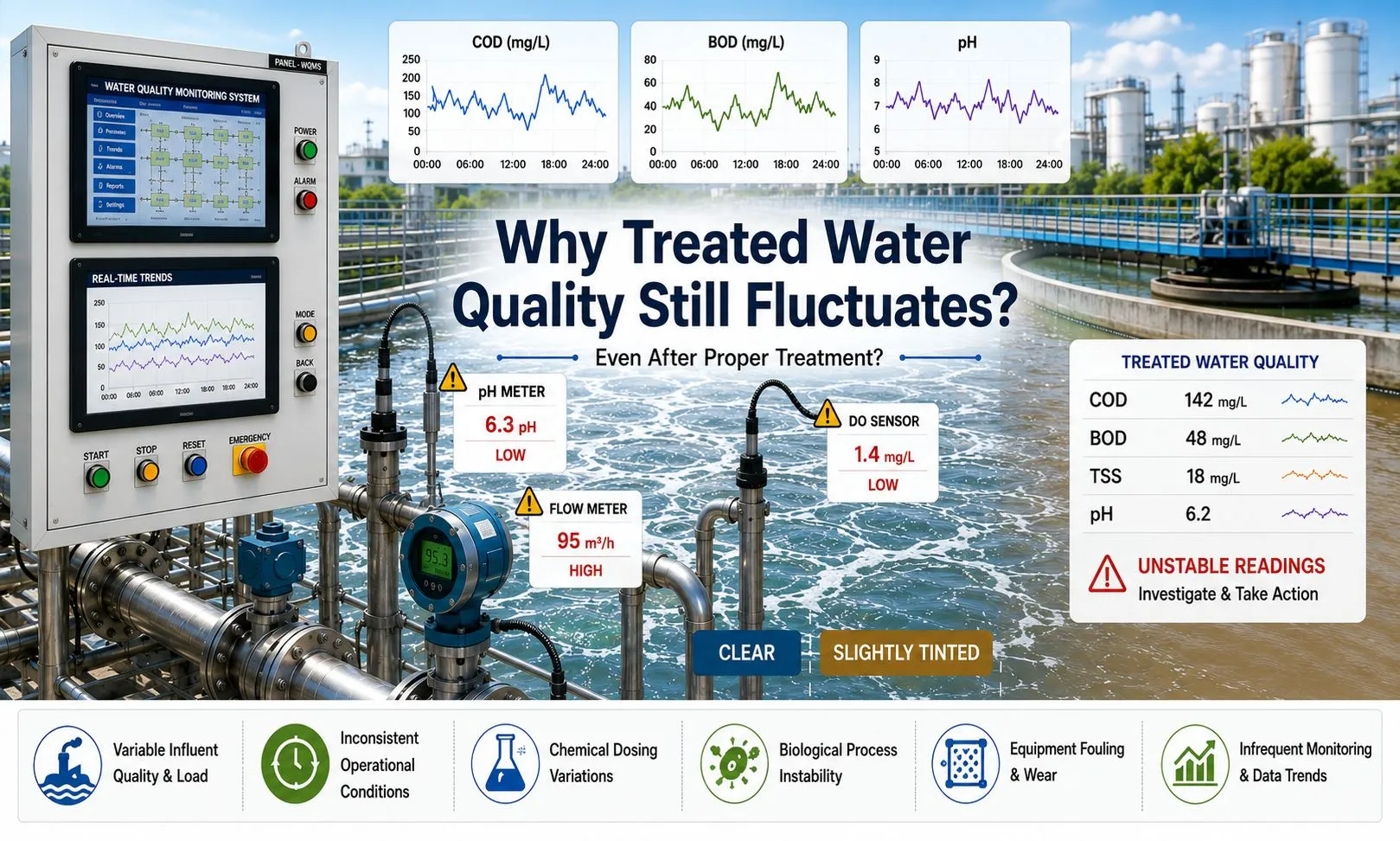
If you are operating a sewage treatment plant (STP) or an effluent treatment plant (ETP), treated water quality fluctuation is a common and often unavoidable challenge in wastewater treatment plants. Even when the plant is running properly, equipment is functioning correctly, and the design complies with CPCB norms, treated water quality fluctuation can still occur.
One day BOD is 12 mg/L, next day 42 mg/L. TSS spikes without warning. COD refuses to stabilize. Operators adjust aeration, change dosing, check pumps — but issue keeps returning.
This is where confusion begins — because technically treatment is happening, but practically the system is not stable.
And that difference is the real problem.
Most sewage treatment plants or Most effluent treatment plants focus only on compliance. If treated water occasionally meets CPCB or BIS standards, system is considered “working”.
But fluctuation creates real risks:
So the issue is not just treatment — it is process stability.
Design assumes steady flow and load. Real wastewater behaves differently:
Especially in decentralized wastewater systems, variation becomes more severe.
If input fluctuates and system does not absorb it, output will fluctuate.
Many plants meet these values sometimes. But fluctuation means instability.
Stability = consistent performance, not occasional compliance.
If equalization is weak, variation directly enters the system.
Equalization becomes ineffective, and instability continues.
Microbial imbalance leads to BOD/COD fluctuation.
Without proper DO control, system fluctuates continuously.
Leads to TSS variation and clarifier issues.
Result: sudden TSS spikes.
Automation exists, but decisions are wrong.
Final output becomes inconsistent.
This case highlights common sewage treatment plant operational problems in residential wastewater treatment systems.
Plant Details:
Issues Observed:
System was running, but not stable.
Key insight: Design was correct. Operation was not.
Effective wastewater treatment plant operation requires continuous monitoring, sludge control, and proper equalization.
Fluctuation becomes common without control systems.
No system gives stability without operational discipline.
Why BOD fluctuates daily?
Because influent and biological activity vary.
Can design eliminate fluctuation?
No — only reduce it.
Is fluctuation acceptable?
Only within limits.
Why equalization is important?
It stabilizes load and flow.
Do decentralized systems fluctuate more?
Yes, due to localized variation.
Across multiple wastewater plants, the same pattern repeats.
Fluctuation is not technology failure — it is operational gap.
Plants designed for steady conditions are operated under variable inputs. That mismatch creates instability.
From Plizma Technology experience, plants that focus on:
achieve stable treated water quality.
Others keep adjusting daily — but fluctuation never stops.
Wastewater is not constant. Treatment must be controlled accordingly.
👉 Also read:
What Is an Effluent Treatment Plant (ETP)? A Complete Guide
👉 Contact: Plizma Technology
2026-09-28
2026-09-23