


2026-09-28



2024-05-08 | by Joydip Manna
In real Water treatment plants, water purification is rarely about hitting a design number once and forgetting it. It is about surviving bad raw water days without violating limits or shutting down downstream processes. Raw water quality changes with season, rainfall, upstream discharge, industrial load, and even time of day. Clarifiers lose settling efficiency, filters break through unexpectedly, and operators are forced into constant chemical adjustments to maintain stability. Inorganic membranes enter the picture not because plants want complexity, but because they need predictability and control—something increasingly important with tightening norms set by bodies such as the Central Pollution Control Board (CPCB) and State Pollution Control Boards (SPCBs).
From an operational standpoint, inorganic membranes are used when a plant can no longer rely on gravity and biology alone to guarantee consistent water quality. They bring a level of reliability that reduces risk and stabilizes downstream systems, especially in industries that must comply with BIS IS 10500 for potable water or CPCB discharge standards.
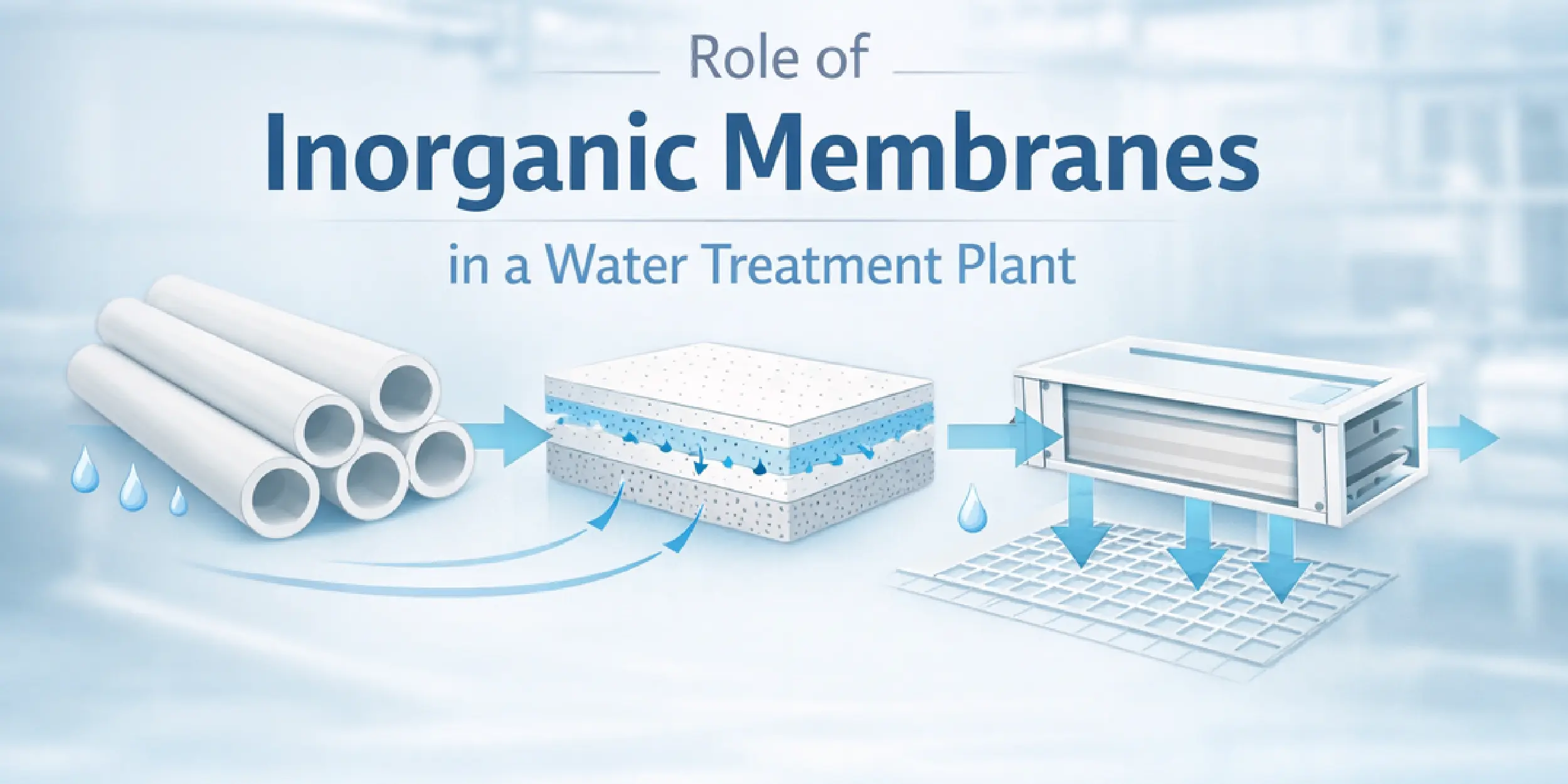
On engineering drawings, inorganic membranes appear as “UF” or “MF blocks.” On site, however, operators understand them as a hard physical barrier—one that does not negotiate with fluctuations in raw water quality.
These membranes are made from ceramic or mineral-based materials with fixed pore structures. Unlike polymer membranes, they do not stretch, swell, shrink, or soften with changes in temperature or chemical exposure. Once installed, their separation limit is permanent. If a particle is larger than the pore, it is physically stopped—every time, without exception.
This makes them fundamentally different from clarifiers or sand filters, which depend on settling velocity, media condition, flow distribution, and accurate chemical dosing to work effectively.
Many plants already have clarifiers and sand filters that work quite well on normal days and even meet compliance standards. But the real challenge starts when unexpected situations happen inside the plant.
For example:
Yahi jagah par inorganic membranes help a lot. They are not meant to solve every upstream problem, but they act as an extra layer of protection. Even if something goes wrong in the treatment process, the membrane helps stop contaminants from reaching the outlet.
This is especially important today because CPCB regulations and online monitoring systems leave very little room for error. One bad day can sometimes lead to a compliance issue.
That’s why many plant operators see membranes as a kind of “insurance layer” for the treatment plant. On good days, they support consistent performance. On difficult days, they help prevent small problems from turning into major compliance failures.
This distinction is essential in design. Membranes handle physical and microbiological quality. Chemical parameters must be controlled through complementary units like RO, softeners, or specialized polishing systems—especially when meeting WHO Drinking Water Guidelines and BIS IS 10500 requirements.
In a functioning plant, membranes are almost never placed at the beginning of the process. They are installed after some form of solids reduction—such as clarification, biological treatment, or coarse filtration.
Water is pushed through the membrane under controlled pressure. Solids accumulate on the surface and are routinely removed by automatic backwashing. When backwashing alone cannot restore flow, chemical cleaning is performed.
Because inorganic membranes are mechanically robust, operators can use stronger cleaning chemicals without risk of media damage.
Inorganic membranes simplify operation but do not eliminate the need for trained monitoring. Operators focus on performance trends rather than isolated numbers.
When membranes foul faster than expected, the root cause is almost always upstream—chemical issues, poor settling, organic surges, or raw water changes.
In India and neighbouring regions, raw water variability is extremely high and operator skill levels vary significantly. In such environments, inorganic membranes perform well because they:
They are especially useful in river-based systems, industrial intake treatment, and reuse applications where any failure has immediate consequences. Compliance with CPCB, SPCB, and National Green Tribunal (NGT) regulations further increases the role of membrane-based reliability.
Plants that treat membranes as a replacement for good design often struggle. Plants that use membranes as a stabilization layer built on top of strong fundamentals usually succeed.
Not when influent quality is unpredictable, seasonal, or when compliance margins are tight.
Yes, they reduce emergency troubleshooting, but operators must still understand performance trends and cleaning logic.
They typically last much longer than polymer membranes when operated within design limits and cleaned correctly.
No. They often reveal upstream problems through fouling patterns and pressure signals.
Yes. They work well in small and medium plants where land, manpower, or consistency are constraints.
From an industry standpoint, organizations like Plizma Technology integrate inorganic membranes into water and wastewater treatment systems across industrial and municipal sectors. Their experience aligns with CPCB, SPCB, BIS requirements—reinforcing the importance of strong pretreatment, operator training, compliance monitoring, and lifecycle-focused design.
Learn more:
View Location
2026-09-28
2026-09-23