

Recent
What Is the Difference Between STP and ETP in Hospitals?
2026-06-19 | by Joydip Manna
What Is the Difference Between STP and ETP in Hospitals?
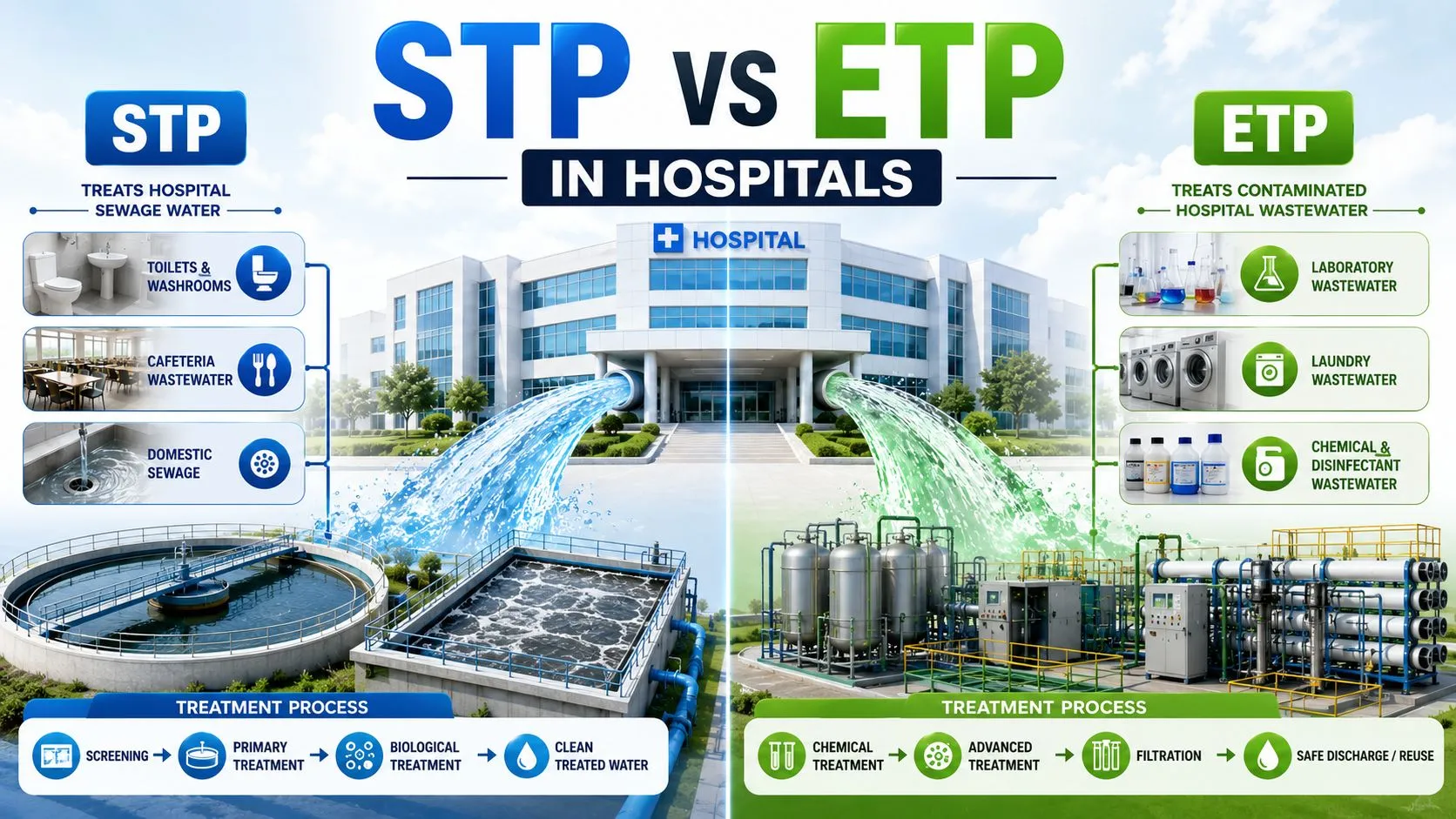
If you are wondering what is the difference between an STP and ETP in a hospital, the answer is not simply that one treats sewage and the other treats industrial wastewater. Hospital wastewater is a different case. It can contain domestic sewage, laboratory wastewater, used disinfectants, floor washings, patient-area washings and other liquid waste generated during healthcare activities.
This is exactly why wastewater treatment in hospitals needs more attention than a normal residential sewage system. As per CPCB guidelines for healthcare facilities, an Effluent Treatment Plant should be provided to treat wastewater generated from the hospital and meet the applicable effluent standards under the Biomedical Waste Management Rules, 2016.
1. Understanding STP in Hospitals
A Sewage Treatment Plant , commonly called STP, is mainly designed to treat sewage generated from domestic activities.
In a hospital, this can include wastewater from toilets, bathrooms, hand washing, kitchens and other routine domestic activities. This wastewater generally contains organic matter, suspended solids, nutrients and microorganisms.
The main objective of an STP is to reduce these pollutants through physical and biological treatment and produce treated water that can meet the applicable discharge or reuse requirements.
A typical sewage treatment process can include screening, equalisation, biological treatment, clarification, filtration and disinfection.
But hospital wastewater does not always remain simple domestic sewage.
There are laboratories, operation areas, cleaning and disinfection activities, laundry operations and patient-care areas. These activities can introduce additional contaminants into the wastewater stream.
This is where ETP treatment becomes important.
2. What Is an ETP in a Hospital?
An Effluent Treatment Plant , or ETP, is designed to treat wastewater whose characteristics require more controlled or specialised treatment.
According to CPCB’s healthcare-facility guidelines, hospital wastewater can come from wards, laboratories, used disinfectants, floor washing, patient areas, hand washing, laundry, accidental spills, firefighting and bathrooms/toilets.
The important part is that not every liquid stream should simply be mixed together and sent into a biological treatment tank.
CPCB specifically states that liquid waste generated from chemicals or discarded disinfectants, infected secretions, aspirated body fluids, laboratory liquids and certain floor-washing, cleaning, housekeeping and disinfection activities should be collected separately and pre-treated before being mixed with the remaining healthcare-facility wastewater.
So, hospital wastewater treatment is really about proper segregation followed by appropriate treatment.
3. Why Hospital ETP Is Different From Normal STP Treatment
An ordinary sewage stream is mostly dominated by domestic organic pollution.
Hospital wastewater can have a more variable composition. Chemical residues, disinfectants and laboratory-related wastewater may affect biological treatment if they are not managed properly.
A biological treatment process depends on microorganisms. If a toxic or inhibitory chemical load suddenly enters the aeration tank, the microorganisms can be affected and treatment performance may drop.
This is one reason equalisation and pre-treatment become important in Hospital wastewater management.
The treatment plant should not only be designed for the average flow. It should also be capable of handling variations in wastewater characteristics.
4. How Does Hospital ETP Work?
CPCB’s healthcare wastewater guidance describes three broad levels of treatment for the combined wastewater.
4.1 Primary Treatment
The primary stage can include equalisation, neutralisation, precipitation and clarification.
Equalisation helps balance variations in flow and pollutant concentration. This is particularly useful in hospitals where wastewater generation is not perfectly uniform throughout the day.
Neutralisation is used when pH correction is required.
Precipitation can help remove certain dissolved or suspended contaminants through chemical treatment, while clarification separates solids from the liquid.
4.2 Secondary Treatment
The secondary stage uses high-rate aerobic biological treatment followed by secondary settling.
Here microorganisms break down biodegradable organic matter under controlled conditions.
The secondary settling tank then separates biological solids from the treated water.
This is where proper aeration, dissolved oxygen control, sludge management and stable operating conditions become important. A biological system cannot be expected to perform properly just because the aeration tank and blower have been installed.
4.3 Tertiary Treatment
The tertiary stage provides additional polishing of the treated wastewater.
CPCB’s hospital wastewater guidance identifies pressure filtration and disinfection before disposal to a drain or sewer.
Disinfection is particularly important in healthcare wastewater because microbial contamination is one of the major concerns.
Depending on the treatment objective and regulatory requirements, filtration and disinfection systems may therefore become a critical final barrier before discharge or reuse.
5. Can a Hospital Have Both STP and ETP?
Yes, and this is where the subject often gets confused.
A hospital generates domestic sewage as well as wastewater from healthcare-related activities. The treatment arrangement therefore needs to be based on the actual wastewater streams.
The question should not be only:
“Should the hospital install STP or ETP?”
The better question is:
“What wastewater is being generated, where is it coming from, what contaminants are present, and what treatment is required before discharge or reuse?”
CPCB’s approach itself recognises this distinction by requiring certain hospital liquid wastes to be separately collected and pre-treated before mixing with the remaining wastewater.
So a STP may be relevant for domestic sewage, while an ETP-based treatment arrangement is required for hospital wastewater that falls under the applicable healthcare effluent requirements.
6. Why Equalisation Is Important in Hospital Wastewater Treatment
Equalisation is not just another tank in the plant layout.
Hospital wastewater can change significantly depending on the time of day and activities taking place inside the facility.
Laboratory operations, cleaning, disinfection, laundry and patient-care activities can create different wastewater characteristics. Without adequate equalisation, these variations can reach the downstream biological process suddenly.
A properly designed equalisation system helps create a more stable feed to the treatment stages.
This improves process control and reduces the risk of sudden shock loading.
7. What Happens If Hospital Wastewater Is Not Treated Properly?
Untreated or inadequately treated hospital wastewater can create environmental and public-health concerns.
Organic matter can consume dissolved oxygen in receiving water bodies. Pathogens can create health risks. Certain chemical contaminants can affect aquatic ecosystems and may also interfere with biological treatment processes.
There is also a compliance issue.
Healthcare facilities have specific responsibilities under India’s biomedical-waste regulatory framework framework, and CPCB guidance links hospital wastewater treatment with compliance with the applicable effluent standards.
So ETP operation should not be treated as a formality for passing inspection.
The plant needs to operate consistently.
8. STP and ETP: The Practical Difference
If you want to understand the difference in the simplest possible way:
An STP primarily deals with domestic sewage.
An ETP deals with wastewater that requires treatment according to its specific pollutant characteristics and regulatory requirements.
In a hospital, the situation becomes more complex because both types of wastewater can be generated in the same premises.
The correct treatment design therefore depends on wastewater source, flow, pollutant load, segregation practices, required treatment quality and applicable consent conditions.
9. Things to Consider Before Designing a Hospital Wastewater Treatment Plant
Before selecting an STP or ETP configuration, several things need to be checked.
First, wastewater sources should be identified properly. Toilets, bathrooms, laboratories, laundry, patient areas and cleaning activities should not simply be considered as one identical wastewater stream.
Second, wastewater characteristics should be understood through testing. Parameters such as pH, BOD, COD, TSS and other relevant contaminants need to be evaluated according to the facility and treatment objective.
Third, segregation and pre-treatment should be planned where required. CPCB specifically identifies certain chemical and infectious liquid waste streams for separate collection and pre-treatment.
Fourth, the biological treatment system needs stable operating conditions. Aeration, sludge return, nutrient balance and dissolved oxygen all affect performance.
Finally, the final treatment and disinfection system needs to be selected according to the required effluent quality and discharge or reuse route.
10. Frequently Asked Questions
10.1 Is STP enough for every hospital?
Not always. Hospitals generate both domestic sewage and healthcare wastewater, so an effluent treatment plant (ETP) may be required for proper hospital wastewater treatment.
10.2 What is the main difference between STP and ETP?
STP mainly treats domestic sewage, while ETP treats wastewater containing specific chemicals, pollutants, and healthcare-related contaminants.
10.3 Why should laboratory wastewater be treated carefully?
Laboratory wastewater may contain chemicals and other contaminants that can disturb biological treatment. CPCB guidance requires certain laboratory liquids to be separately collected and pre-treated.
10.4 Does hospital ETP require biological treatment?
Yes, biological treatment can be an important stage in a hospital ETP plant. It helps microorganisms break down biodegradable organic pollutants in wastewater.
10.5 Is disinfection necessary in hospital wastewater treatment?
Yes, disinfection is an important part of tertiary treatment for reducing pathogens. It helps the treated wastewater meet applicable discharge requirements.
10.6 Can treated hospital wastewater be reused?
Treated hospital wastewater may be reused for suitable non-potable applications when required quality standards are achieved. Water reuse can also help reduce freshwater consumption.
11. Conclusion
The difference between STP and ETP in hospitals mainly depends on the type of wastewater being treated and the contaminants that need to be removed.
An STP (Sewage Treatment Plant) primarily treats domestic sewage, while a hospital ETP (Effluent Treatment Plant) is designed to manage more complex wastewater generated from healthcare-related activities.
Considering hospital wastewater as ordinary domestic sewage can create treatment challenges. Hospitals have laboratories, patient-care areas, laundry facilities, cleaning operations and regular disinfectant use, which can introduce additional contaminants into the wastewater stream.
Therefore, effective hospital wastewater treatment may involve proper wastewater segregation, pre-treatment, equalization, biological treatment, filtration and disinfection, depending on the characteristics of the wastewater and the required treated-water quality.
CPCB guidance also addresses the separate collection and pre-treatment of specified chemical and infectious liquid wastes, while combined hospital wastewater can undergo primary, secondary and tertiary treatment through an appropriate ETP plant.
Ultimately, hospital wastewater management is not simply about choosing between an STP and an ETP. The treatment system needs to be selected according to the actual wastewater characteristics, applicable requirements and operating conditions. Proper engineering and consistent operation are essential for maintaining reliable treatment performance.
For hospital wastewater treatment systems, Plizma Technology approaches the subject from the practical side—understanding the wastewater first, then matching the treatment process to the actual requirement.
RECENT BLOG
ETP for Jute Mill Wastewater Treatment in West Bengal: Improving Treatment Reliability
2026-10-22
ETP for Sugar Mills in India: A Practical Guide to Wastewater Treatment and Water Reuse
2026-10-14
Top 5 STP Manufacturers in Chhattisgarh
2026-09-28
Top 5 ETP Plant Manufacturers in Chhattisgarh
2026-09-28