
2026-09-28



2026-05-24 | by Joydip Manna
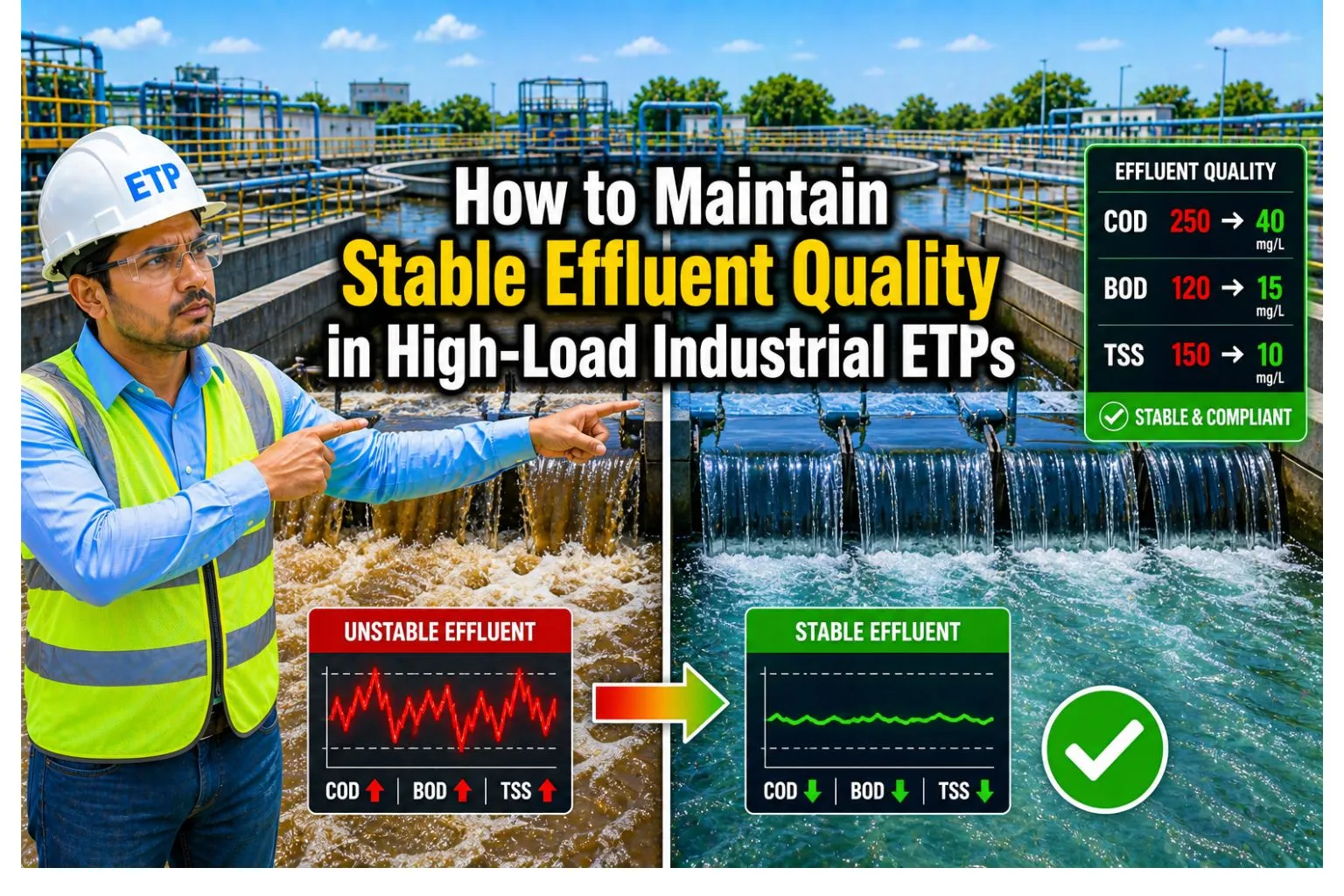
Maintaining stable effluent quality in high-load industrial ETPs is not something that gets fixed at design stage and then forgotten… this assumption itself creates problem later. On drawings everything looks controlled — flow, load, retention time — but once plant starts running, conditions start shifting slowly, then suddenly also sometimes. Influent variation comes, operator makes adjustments, batch discharge happens, aeration slightly reduced… all these small things start adding up.This is where ETP process control and wastewater load management become important.
And CPCB limits, they don’t change. Plant has to adjust, not the regulation. That gap, this is where real pressure builds inside system.
In industries like textile, pharma, chemical… influent is never stable, practically speaking. One shift COD low, next shift suddenly high due to batch discharge or washing. These wastewater flow fluctuations can create sudden changes in the organic loading reaching the treatment system. pH swings also seen within hours, not days.
Still system expected to meet: BOD 30 mg/L, COD 250 mg/L, TSS 100 mg/L… continuously, not sometimes. Plant has to absorb everything internally. No external correction once water enters.
In real ETP operation, instability does not come from one big failure… it builds from small repeated actions. Batch discharge increases industrial wastewater load, cleaning chemicals disturb biology, equalization tank sometimes bypassed during peak, aeration reduced to save power, sludge wasting delayed.
Individually these look manageable, but together they disturb the wastewater treatment process. When outlet fluctuates, focus usually shifts to tertiary treatment… but actual problem already created upstream.
Stable effluent is not one sample passing lab test. It means treated effluent quality remains consistent, without sudden spikes in COD, BOD, TSS or pH, even during peak loading.
The biological system should remain active, not continuously stressed.
Regulatory compliance is not only about one-time sampling. Consistent effluent quality and controlled discharge are important parts of proper ETP operation.
The equalization tank is where stability actually begins, but many plants treat it like just holding tank.
It needs proper retention, continuous mixing and pH correction where required. If mixing stops or becomes poor, stratification happens… then shock load directly reaches biological treatment.
Many instability cases, if traced properly, origin is here only.
The biological treatment system, whether activated sludge or another process, depends heavily on stable conditions.
MLSS, DO, F/M ratio and SRT need to remain within the operating range of the process. If oxygen drops for several hours, biological activity and settling can start getting affected.
Then problems appear — sludge bulking, poor settling, TSS carryover and unstable COD/BOD removal.
Recovery takes time, not immediate.
Some industrial wastewater contains solvents, heavy metals, dyes and toxic chemicals. If these directly enter the aeration tank, biomass can get affected badly.
This is why toxic stream segregation, pretreatment and proper industrial effluent characterization are important.
After a major toxic shock, microorganisms need time to recover and regrow. During this period, effluent quality becomes unstable.
Sludge management looks secondary, but actually very critical.
Proper sludge wasting, RAS control, MLSS and SRT management are necessary for stable biological treatment.
Improper sludge control leads to poor clarification and solids carryover.
The clarifier usually is not creating instability, it is showing it.
High hydraulic loading, poor sludge return or bad settling characteristics can cause solids to escape with treated effluent. Then TSS increases, and COD may also rise.
Many adjustments are made here, but root cause remains upstream — biological instability, hydraulic shock or poor sludge management.
Very common mistake — using filters, activated carbon or RO to correct unstable biological treatment.
Tertiary systems are mainly polishing units. If feed quality is unstable, RO fouling, filter clogging and higher chemical consumption can happen.
Cost goes up, problem stays.
Not complicated solutions, but controlled operation.
Strong equalization, stable flow into biology, proper MLSS and DO control, toxic stream segregation, regular sludge wasting and pH control… these things matter more.
Aeration efficiency, stable clarifier operation and basic automation for pH, DO and flow monitoring also help.
And operator understanding — this is critical but often ignored.
Stability always comes with cost.
More equalization means more land. More aeration means more power. Automation increases CAPEX. Sludge handling remains continuous OPEX.
So every effluent treatment plant balances between treatment stability, CAPEX, OPEX, compliance and water reuse requirements.
No perfect solution.
Why effluent fluctuates after commissioning?
Because real influent varies, design assumes steady load.
Most critical unit?
Equalization tank.
Can RO fix instability?
No, only polishing.
How often sludge should be wasted?
Regular, usually daily controlled.
Is automation required?
Yes, especially for high-load systems.
Why pH control fails?
Because correction happens after EQ instead of inside it.
Stable effluent quality is not achieved by adding more treatment units. It is achieved by controlling variation before it reaches sensitive units.
Most plants invest in tertiary systems… but instability always begins upstream.
Plizma Technology observations — systems rarely fail because design is wrong. They fail because operation and real load behavior are not aligned.
👉 Also read:
How To Choose the Best Partner for Advanced Wastewater Solutions
👉 Contact:
Plizma Technology
2026-09-28
2026-09-23