

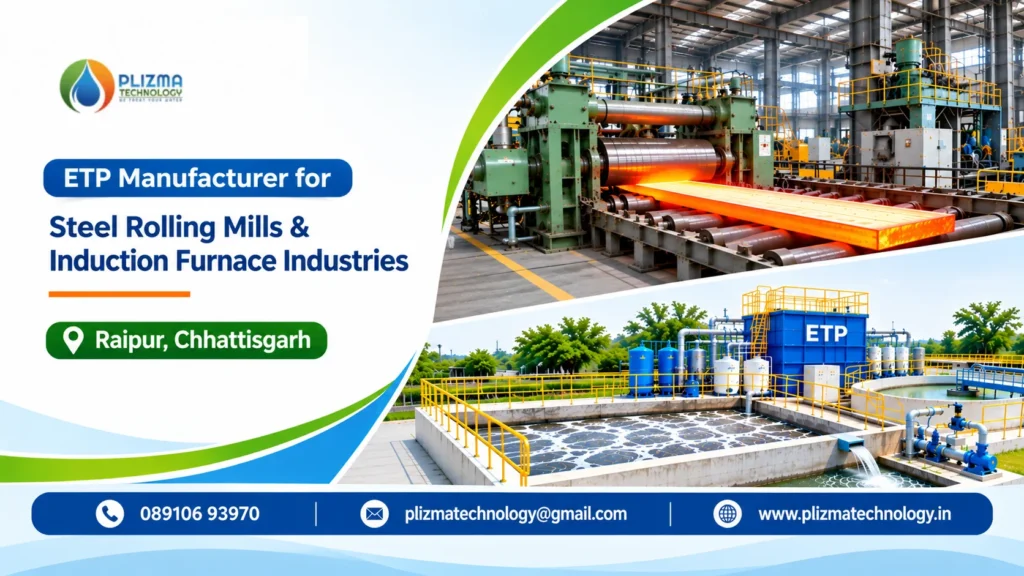
Steel manufacturing is one of the important industrial activities in Raipur, Chhattisgarh. With the growing number of steel rolling mills, induction furnace units and metal processing industries, industrial wastewater management has become an important operational concern.
If you are operating a steel rolling mill or induction furnace, you already know that water is required at different stages of manufacturing. From furnace cooling and machinery operations to descaling and rolling processes, water plays an important role in maintaining production efficiency. But what happens when this water becomes contaminated?
Industrial wastewater may contain mill scale, iron particles, suspended solids, oil and grease, dissolved salts and other process-related contaminants. Releasing such wastewater without proper treatment can create environmental problems and regulatory complications.
This is where an Effluent Treatment Plant (ETP) becomes necessary.
Selecting the right ETP manufacturer in Raipur is therefore an important decision for steel manufacturing industries. A properly designed industrial wastewater treatment plant helps remove contaminants, improve water quality and support wastewater recycling for suitable industrial applications.
However, selecting an effluent treatment plant manufacturer for steel rolling mills and induction furnace industries requires a proper understanding of industrial wastewater characteristics. A conventional wastewater treatment system may not be suitable for handling the heavy suspended solids and metal-related contaminants generated by steel manufacturing operations.
In this article, we will explain how ETP plants work for steel industries, which treatment technologies are commonly used, what regulatory requirements need attention and how industries in Raipur can evaluate an appropriate industrial ETP manufacturer.
What Is an Effluent Treatment Plant for Steel Industries?
An Effluent Treatment Plant is an industrial wastewater treatment system designed to remove physical, chemical and biological pollutants from industrial effluent before its discharge or reuse.
In steel manufacturing facilities, ETP plants are generally designed around the characteristics of wastewater generated during production, cooling, cleaning and other industrial operations.
Unlike domestic sewage, steel industry wastewater may contain high concentrations of suspended inorganic particles, iron oxide, oil, grease and dissolved minerals.
A properly designed industrial effluent treatment plant generally uses a combination of:
- Physical wastewater treatment
- Chemical treatment
- Sedimentation and clarification
- Filtration systems
- Industrial sludge dewatering
- Advanced wastewater treatment wherever required
The objective is not simply to make wastewater visually clear. The treatment system must achieve the required effluent quality for the intended discharge or industrial water reuse application.
This is why choosing an experienced industrial ETP plant manufacturer becomes important for manufacturing facilities.
Why Steel Rolling Mills Require an ETP Plant
Steel rolling mills generate wastewater through several manufacturing activities. During the rolling process, steel passes through different stages of mechanical processing, cooling and surface treatment.
Water comes into contact with hot metal surfaces, equipment and lubricants, which can introduce different contaminants.
1. Mill Scale and Iron Oxide Removal
Mill scale is one of the major contaminants associated with steel rolling mill wastewater.
It consists mainly of iron oxides formed on hot steel surfaces during manufacturing.
When these particles enter wastewater, they can settle inside pipelines, collection tanks and treatment equipment.
If proper mill scale separation is not provided, accumulation may cause:
- Pipeline choking
- Pump wear and damage
- Reduced settling tank capacity
- Increased sludge generation
- Higher maintenance requirements
Therefore, a suitable mill scale removal system is an important part of ETP design for steel rolling mills.
2. Oil and Grease Contamination
Rolling mills use lubricants and hydraulic oils during different production activities.
Some of these substances may enter wastewater through equipment leakage, cleaning operations and floor washing.
Oil and grease can interfere with downstream treatment processes, particularly chemical coagulation and filtration.
Oil separators or dissolved air flotation systems may be considered depending on the concentration and physical condition of the oil.
3. Suspended Solids in Wastewater
Steel rolling mill wastewater may contain fine iron particles, scale residues and other suspended materials.
These particles increase total suspended solids (TSS) and need proper removal through settling, coagulation and filtration.
An industrial wastewater treatment plant designed for steel manufacturing must therefore consider the nature and concentration of these suspended solids.
Why Induction Furnace Industries Need Specialized Wastewater Treatment
Induction furnace industries have different wastewater characteristics compared with conventional rolling mills.
The primary requirement is often associated with cooling water management, equipment protection and wastewater generated through auxiliary operations.
Common wastewater sources include:
- Induction furnace cooling circuits
- Cooling tower blowdown
- Equipment cleaning
- Floor washing
- Wet scrubber wastewater, where applicable
1. Furnace Cooling Water Management
Induction furnaces require controlled cooling to maintain safe operating temperatures and protect furnace components.
Many facilities use recirculating cooling water arrangements.
However, water quality must be maintained properly to avoid scaling, corrosion, fouling and suspended solids accumulation.
An appropriate industrial water treatment system helps maintain cooling water quality and supports equipment reliability.
2. Cooling Tower Blowdown
Cooling towers remove heat through evaporation. During continuous operation, dissolved minerals gradually concentrate in the circulating water.
A portion of this water is periodically removed as blowdown to control dissolved solids.
Depending on its characteristics, cooling tower blowdown may require pH adjustment, filtration, softening or membrane treatment before reuse or disposal.
3. Wet Scrubber Wastewater
Some induction furnace facilities use wet scrubbing arrangements for air pollution control.
The water used in these systems can collect particulate matter and other pollutants from the gas stream.
Such wastewater may require separate collection, settling, chemical treatment and sludge handling.
It is important that different wastewater streams are characterized separately before combining them into a common ETP.
Major Treatment Processes Used in Steel Industry ETP Plants
A steel industry ETP generally operates through several treatment stages. Each stage removes specific contaminants and prepares wastewater for the next treatment process.
1. Preliminary Treatment: Screening and Settling
The first stage removes large particles, metallic debris and heavier suspended materials.
Screening arrangements prevent unwanted materials from entering pumps and downstream equipment.
Settling chambers and scale pits help separate heavier particles such as mill scale and iron oxide.
This stage reduces the solids loading on subsequent treatment units.
2. Equalization Tank
Wastewater generation in steel manufacturing is not always uniform.
Production schedules, cooling operations, maintenance and cleaning activities can cause variations in flow and pollutant concentration.
An equalization tank helps maintain a more consistent wastewater flow.
It also provides mixing and reduces sudden variations in wastewater characteristics, allowing downstream treatment equipment to operate more consistently.
3. Oil and Grease Separation
Oil separators are installed to remove free-floating oil and grease from wastewater.
Where stable oil emulsions are present, additional chemical treatment or dissolved air flotation (DAF) may be required.
The selection depends on wastewater testing rather than assumptions about the production process.
4. Coagulation and Flocculation
Chemical treatment is an important part of steel industry wastewater management.
Fine suspended particles may not settle effectively through ordinary gravity separation.
Coagulation destabilizes these particles, while flocculation helps them combine into larger aggregates.
Commonly used treatment chemicals include:
- Alum
- Ferric chloride
- Polyaluminium chloride (PAC)
- Polymer-based flocculants
- Lime and other pH adjustment chemicals
Jar testing helps determine suitable chemical combinations and dosing requirements.
Incorrect chemical dosing can increase sludge generation and operating expenses. This is one of the reasons why chemical treatment should be properly evaluated during ETP design.
5. Clarification
After chemical treatment, wastewater enters a clarifier.
The larger suspended particles and chemical flocs settle under gravity.
The clarified water moves towards the next treatment stage, while settled sludge is collected from the bottom.
Depending on plant capacity and available space, conventional clarifiers or lamella clarifiers may be selected.
6. Pressure Sand Filtration
After clarification, water may still contain fine suspended particles.
Pressure sand filters help remove these remaining solids and improve the quality of treated water.
Backwashing arrangements are required to maintain filtration performance.
7. Activated Carbon Filtration
Activated carbon filters may be used where residual organic compounds, colour or certain other impurities need further removal.
Their suitability depends on the actual wastewater characteristics and reuse requirements.
8. Reverse Osmosis Treatment
Reverse osmosis may be considered when dissolved salts and high TDS prevent the treated water from being reused in the intended industrial application.
RO membranes separate dissolved salts from water under pressure.
However, RO requires suitable pretreatment and a planned arrangement for handling the concentrate stream.
It is not necessary for every steel industry ETP.
9. Industrial Sludge Dewatering
The ETP generates sludge through sedimentation and chemical treatment.
This sludge contains suspended solids, iron oxide particles and chemical precipitates.
A filter press or another suitable industrial sludge dewatering system helps reduce moisture content and makes sludge handling easier.
The final disposal or recovery arrangement must be decided after assessing the sludge characteristics and applicable waste-management requirements.
ETP Solutions for Different Steel Manufacturing Applications
Different steel manufacturing processes require different wastewater treatment arrangements.
ETP for Steel Rolling Mills
A rolling mill ETP generally focuses on removing:
- Mill scale
- Iron oxide particles
- Suspended solids
- Oil and grease
- Other process-related impurities
Scale pits, settling tanks, oil separators, chemical dosing systems, clarifiers and filtration units may form part of the industrial effluent treatment system.
ETP for Induction Furnace Industries
An induction furnace ETP may involve:
- Cooling water treatment
- Suspended solids removal
- Cooling tower blowdown treatment
- pH correction
- Chemical treatment
- Filtration and water reuse arrangements
The system should be designed according to the actual wastewater generated by the facility.
ETP for Integrated Steel Manufacturing Units
Some facilities operate both induction furnaces and rolling mills.
In such cases, wastewater streams may have different characteristics and treatment requirements.
Separate collection and preliminary treatment may be required before combining compatible streams into a common treatment system.
This helps prevent excessive pollution loading and improves overall process control.
ETP Manufacturer in Raipur, Chhattisgarh: Industrial Areas and Design Considerations
Raipur has several industrial locations, including Siltara, Urla and Borjhara, where manufacturing activities require proper wastewater management.
Steel rolling mills, induction furnace industries and metal processing units operating in these industrial areas may require customized industrial wastewater treatment solutions.
An ETP manufacturer in Siltara, Raipur or an industrial ETP supplier serving the Urla industrial area should understand the wastewater characteristics of individual manufacturing facilities before recommending a treatment configuration.
But choosing an ETP capacity simply based on production output is not a reliable approach.
The actual wastewater generation, pollution concentration and intended reuse quality must be evaluated first.
1. Wastewater Analysis
Before designing an industrial effluent treatment plant, samples should be collected and tested.
Important parameters include:
| Parameter | Purpose |
|---|---|
| pH | Measures acidity or alkalinity |
| TSS | Measures suspended solids |
| TDS | Measures dissolved solids |
| COD | Indicates chemically oxidizable pollution |
| BOD | Indicates biodegradable organic pollution |
| Oil and grease | Identifies oil contamination |
| Iron | Helps evaluate iron-related contamination |
| Temperature | Helps assess cooling water conditions |
These results help engineers select the appropriate industrial wastewater treatment technology.
2. Industrial ETP Plant Capacity
ETP capacity is generally expressed in KLD, meaning kilolitres per day.
The capacity should consider:
- Average wastewater generation
- Maximum wastewater flow
- Operating hours
- Production variations
- Future expansion
- Required treatment efficiency
For example, a facility generating 100 KLD of wastewater requires a hydraulic design based on its actual flow profile, not merely a 100 KLD label on the equipment.
3. Space Availability
Steel manufacturing facilities often have limited space around existing production infrastructure.
The ETP layout should consider tank dimensions, equipment access, chemical storage, sludge handling and maintenance requirements.
A compact industrial ETP can be useful, but equipment should not be placed so closely that maintenance and operation become difficult.
4. Industrial Water Recycling Requirements
Water recycling can help reduce freshwater consumption in steel industries.
An industrial water recycling plant helps recover treated wastewater for suitable applications.
Treated wastewater may be considered for:
- Cooling tower makeup
- Equipment washing
- Floor cleaning
- Suitable industrial process applications
The required treatment quality varies according to the intended reuse application.
For example, cooling tower makeup water may require control of hardness, conductivity, silica and dissolved solids in addition to suspended solids.
5. Automation and Monitoring
Modern ETP systems can incorporate PLC and SCADA arrangements, pH sensors, flow meters, level transmitters and automatic chemical dosing.
These systems help operators monitor plant performance and identify process variations.
Regular laboratory testing remains necessary even when online monitoring instruments are installed.
Why Industries in Siltara and Urla Need Specialized ETP Plants
Industrial areas such as Siltara and Urla have different manufacturing facilities where industrial wastewater management requires proper planning.
Steel rolling mills, induction furnace units and metal processing industries generate wastewater with different pollution characteristics.
An industrial ETP plant in Raipur should therefore be designed according to the wastewater generated by individual manufacturing operations.
Mill scale removal, iron particle separation, oil and grease treatment and suspended solids reduction are some important considerations.
Choosing an experienced Effluent Treatment Plant manufacturer in Chhattisgarh helps industries evaluate their wastewater characteristics and select appropriate treatment technologies.
A customized industrial wastewater treatment plant can also help address differences in hydraulic loading, available installation space and treated water quality requirements.
Environmental Regulations for Steel Industries in Chhattisgarh
Industrial wastewater treatment in India comes under the Water (Prevention and Control of Pollution) Act, 1974 and the Environment (Protection) Act, 1986, along with applicable rules and notifications.
The Central Pollution Control Board (CPCB) provides national pollution-control standards and guidance.
In Chhattisgarh, the Chhattisgarh Environment Conservation Board (CECB) is responsible for implementing pollution-control requirements and issuing applicable industrial consents.
Steel industries must consider their Consent to Establish (CTE), Consent to Operate (CTO), applicable discharge standards and specific regulatory directions.
General Effluent Discharge Standards
The general standards under Schedule VI of the Environment (Protection) Rules, 1986 for discharge into inland surface water include:
| Parameter | General Limit |
|---|---|
| pH | 5.5–9.0 |
| Suspended solids | 100 mg/L |
| Oil and grease | 10 mg/L |
| BOD (3 days at 27°C) | 30 mg/L |
These are general reference standards. Industry-specific standards and consent conditions may prescribe different or stricter requirements.
Zero Liquid Discharge and Industrial Wastewater Recycling
Zero Liquid Discharge (ZLD) involves managing wastewater so that liquid effluent is not discharged outside the facility.
Some industrial facilities may be subject to ZLD or specific wastewater reuse requirements under applicable environmental directions and consent conditions.
However, ZLD should not be assumed to be universally mandatory for every steel rolling mill or induction furnace in Raipur.
The actual regulatory requirements must be verified from the industry’s CECB consent documents.
How to Select the Right ETP Manufacturer in Raipur?
Selecting an ETP manufacturer is an important decision because treatment performance depends on both engineering design and operating support.
Here are some important considerations.
1. Industrial Wastewater Treatment Experience
The manufacturer should understand steel industry wastewater, including mill scale, iron particles, cooling water and oil contamination.
Experience in domestic sewage treatment alone does not establish the ability to design an industrial ETP.
2. Customized ETP Plant Design
Every manufacturing facility has different wastewater characteristics.
The manufacturer should evaluate wastewater samples, daily flow, peak loading, available space and treated water requirements before recommending equipment.
3. Industrial Equipment Quality
The major equipment should be selected according to the actual operating conditions.
Important components include pumps, agitators, dosing systems, clarifiers, filtration units, filter presses and control panels.
4. ETP Installation and Commissioning
Proper installation, hydraulic testing, equipment inspection and chemical dosing calibration are essential.
Commissioning should also include treatment performance verification under representative operating conditions.
5. ETP Operation and Maintenance Support
An industrial ETP requires regular inspection, sludge removal, chemical management, filter backwashing and equipment maintenance.
Availability of technical support and spare parts is an important consideration for uninterrupted industrial operations.
Common ETP Operating Problems in Steel Industries
Even a well-designed industrial wastewater treatment plant may experience operational problems when maintenance and process control are neglected.
Some common issues include:
Mill scale accumulation: Excessive scale entering the ETP can reduce tank capacity and create problems in pumps and pipelines.
High suspended solids: Inadequate settling or chemical treatment can result in poor clarification.
Oil contamination: Improper oil separation may interfere with downstream treatment and filtration.
Chemical overdosing: Excessive coagulant and polymer dosing increases sludge generation and chemical expenses.
High TDS: Dissolved salts can accumulate in recirculating water and affect reuse applications.
Filter choking: High solids loading can increase pressure drop and reduce filter performance.
Unstable pH: Variations in incoming wastewater may affect chemical treatment efficiency.
Regular monitoring, laboratory analysis and preventive maintenance help operators identify these problems before they affect the complete treatment process.
Industrial Water Recycling: Reducing Freshwater Consumption in Steel Plants
Water recycling has become an important consideration for modern steel manufacturing facilities.
An industrial water recycling plant helps recover treated wastewater for suitable applications, reducing dependence on freshwater sources.
Depending on the treated water quality, recycled water may be used for cooling tower makeup, equipment washing and other industrial operations.
For steel rolling mills and induction furnace industries, an effective wastewater recycling system can support better water management and improve overall resource utilization.
However, water reuse should always be based on the required quality for each application. Proper filtration, softening and membrane treatment may be needed in certain situations.
Industries should evaluate technical experience, wastewater testing, customized design, equipment quality, installation, commissioning, regulatory understanding and after-sales support.
Conclusion
Steel rolling mills and induction furnace industries play an important role in the industrial development of Raipur and Chhattisgarh. However, increasing manufacturing activities also create a greater responsibility for managing industrial wastewater properly.
An appropriately designed Effluent Treatment Plant helps remove mill scale, suspended solids, oil and grease, and other process-related pollutants. From preliminary screening and equalization to chemical treatment, clarification, filtration and sludge dewatering, every treatment stage contributes to the overall performance of the system.
The selection of an ETP manufacturer in Raipur should depend on actual wastewater characteristics, production capacity, water recycling requirements and applicable environmental conditions.
It is also important to understand that an ETP is not simply a collection of tanks and equipment. Its long-term performance depends on engineering design, chemical dosing, energy consumption, sludge handling, regular maintenance and operator knowledge.
At Plizma Technology, industrial wastewater management is considered an important part of responsible manufacturing development. Understanding the wastewater generated by individual industries and selecting suitable treatment technologies are essential steps towards effective industrial water management.
For steel rolling mills and induction furnace industries in Raipur, wastewater treatment is not only about managing industrial discharge. It is also about conserving water resources, maintaining production reliability and supporting responsible industrial growth.