2026-09-23



2026-06-19 | by Joydip Manna
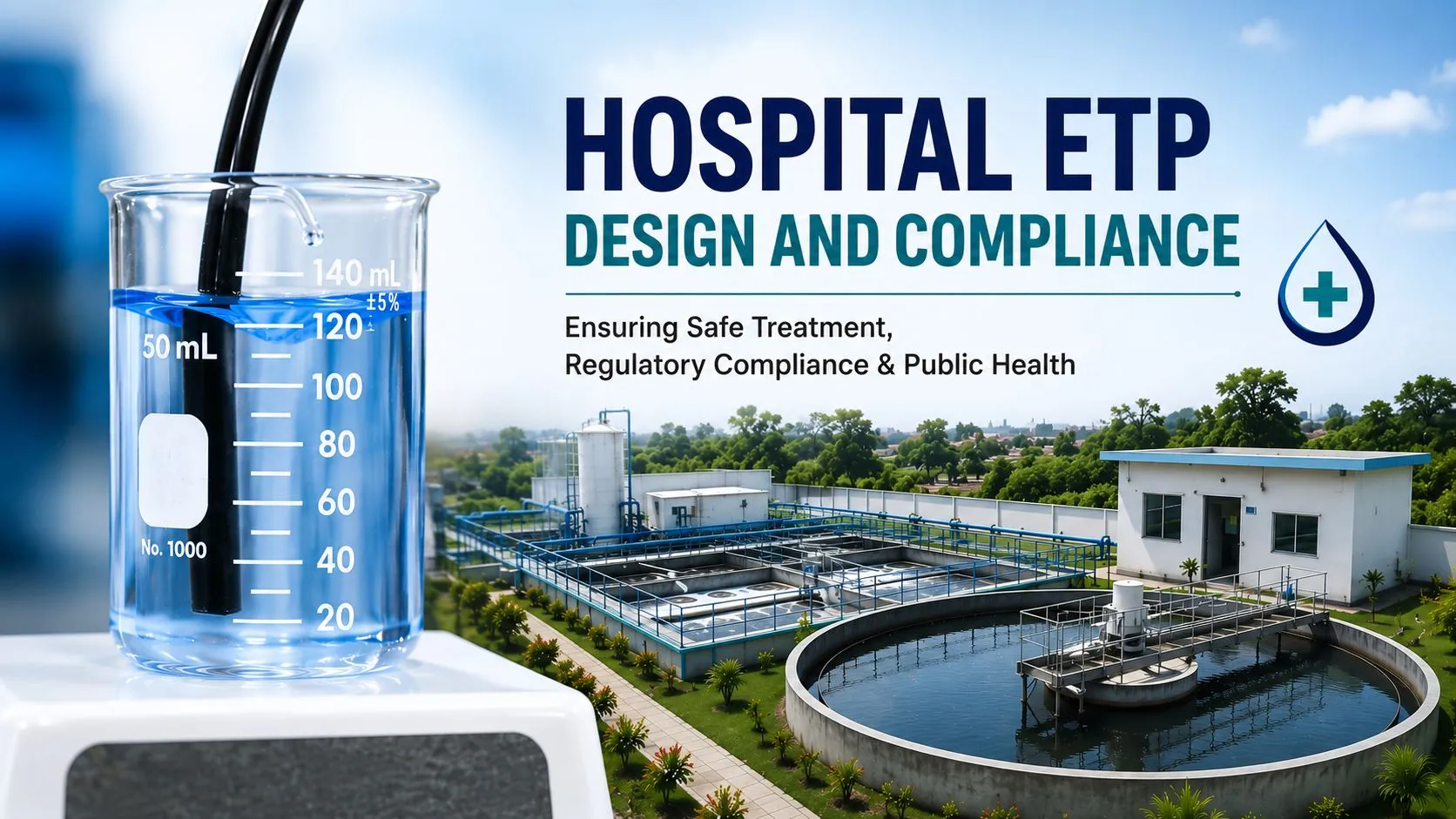
Hospital wastewater is not ordinary sewage, and that is where many projects start with a wrong assumption. A hospital may discharge water from operation theatres, pathology laboratories, ICUs, dialysis units, laundries, kitchens, pharmacies, and patient wards all at the same time. Every stream carries different pollutants. Some contain organic matter, some contain disinfectants, while others may carry pharmaceutical residues or pathogenic microorganisms. Because of this mixed wastewater profile, hospitals require a treatment system that is designed specifically for healthcare applications instead of simply installing a conventional sewage treatment plant.
In Chhattisgarh, environmental compliance has become much stricter over the last few years. Regulatory authorities now look beyond whether an Effluent Treatment Plant (ETP) exists. They also verify whether the plant is operating consistently, whether treated water meets discharge standards, whether sludge is disposed through authorized channels, and whether proper monitoring records are maintained. Quite often hospitals invest significantly in treatment infrastructure but later struggle during inspections because maintenance records, laboratory reports, or calibration documents are incomplete. The treatment plant may be functioning properly, but compliance extends far beyond equipment alone.
This is exactly why Hospital ETP design should always begin with understanding the wastewater characteristics, future hospital expansion, regulatory obligations, and operational realities instead of simply selecting treatment machinery.
Unlike domestic sewage, hospital wastewater contains a combination of biological, chemical, and pharmaceutical contaminants. Every department contributes wastewater with different characteristics, making treatment much more complicated than conventional municipal sewage.
A typical hospital wastewater stream may contain:
The challenge is not only removing visible pollution. Many contaminants are dissolved and cannot be removed through simple sedimentation or filtration. Biological treatment, chemical conditioning, and final disinfection all become essential parts of the treatment process.
Hospitals operating in Chhattisgarh must comply with multiple environmental regulations depending upon their size, wastewater generation, and discharge arrangements.
The important regulatory framework generally includes:
Many hospital management teams believe obtaining Consent to Operate is the final compliance requirement. Actually, that is only the beginning. Authorities also expect regular wastewater testing, operational logbooks, preventive maintenance records, sludge disposal documentation, laboratory reports, and calibration certificates wherever monitoring equipment is installed. Missing documentation can become a compliance issue even when treated water quality remains satisfactory.
Although every hospital has different wastewater characteristics, the treatment philosophy generally remains similar. Multiple treatment stages work together to gradually remove pollutants before discharge or reuse.
Wastewater first passes through coarse and fine screens where plastics, cloth, gauze, bandages, sanitary waste, and other floating materials are removed. If these materials enter pumps or blowers, equipment damage becomes much more likely.
Hospital wastewater rarely arrives at a constant flow rate. Peak discharge usually occurs during morning operations, laboratory activity, laundry cycles, and cleaning schedules.
The equalization tank balances both flow and pollutant concentration before wastewater enters the biological treatment process. Without equalization, sudden hydraulic shocks can reduce biological treatment efficiency.
Laboratories and cleaning chemicals sometimes create wastewater with fluctuating pH values. Automatic chemical dosing systems maintain the desired pH range so that microorganisms responsible for biological treatment remain healthy.
This is the heart of the hospital ETP.
Microorganisms consume dissolved organic pollutants and convert them into stable biological solids. Depending upon project requirements, hospitals generally use technologies such as Moving Bed Biofilm Reactor (MBBR), Sequential Batch Reactor (SBR), Activated Sludge Process (ASP), or Membrane Bioreactor (MBR).
The technology selection depends on available land, wastewater quality, discharge standards, operational manpower, automation requirements, and future expansion rather than simply choosing the lowest-cost system.
After biological treatment, mixed liquor enters the clarifier where biological sludge settles naturally. The clarified water moves forward for polishing while settled sludge is either returned to the aeration process or sent for sludge handling.
Pressure Sand Filters remove remaining suspended particles, while Activated Carbon Filters reduce colour, odour, and residual dissolved organics. This stage significantly improves treated water quality before final disinfection.
Since hospital wastewater may contain harmful microorganisms, disinfection becomes one of the most critical treatment stages.
Hospitals generally use ultraviolet disinfection or sodium hypochlorite dosing depending upon design philosophy and regulatory requirements.
Once treated water satisfies required quality standards, it may be discharged or reused for approved non-potable purposes such as flushing, gardening, cooling towers, or utility washing wherever regulations permit.
Treatment does not end after producing clean water.
Biological sludge generated during treatment requires thickening, dewatering, storage, and disposal through authorized agencies. Poor sludge management can create operational and regulatory problems even when the liquid treatment process performs efficiently.
Designing an efficient hospital ETP involves much more than calculating daily wastewater volume.
Engineers usually evaluate several operational factors before finalizing plant capacity.
These include:
One common mistake is designing the plant only for current occupancy. Hospitals often expand over time, and an undersized treatment plant can become overloaded within just a few years. Providing additional design capacity during the initial stage is usually more economical than retrofitting the system later.
Several biological treatment technologies are available for hospital ETPs, and the final selection depends on wastewater characteristics, hospital size, available land, discharge standards, operational budget, and future expansion plans.
Moving Bed Biofilm Reactor (MBBR) has become one of the preferred technologies for medium and large hospitals because it offers excellent biological treatment within a compact footprint. Biofilm carriers increase treatment efficiency while allowing the system to handle fluctuations in organic loading more effectively.
Sequential Batch Reactor (SBR) is widely used where wastewater flow changes significantly during the day. Since treatment takes place in batches, SBR systems can maintain stable treatment performance even when inflow varies considerably. Automation also becomes comparatively easier.
Activated Sludge Process (ASP) continues to be a reliable option for larger healthcare facilities that have sufficient land available. Although this technology has been used successfully for decades, it generally requires experienced operators, continuous aeration, and careful sludge management to maintain treatment efficiency.
Membrane Bioreactor (MBR) combines biological treatment with membrane filtration to produce exceptionally high-quality treated water. Hospitals planning treated water reuse often consider MBR because it removes suspended solids very effectively. However, membrane cleaning and replacement increase operational costs compared to conventional biological systems.
Choosing the right technology should never be based only on initial capital investment. Long-term operating costs, electricity consumption, maintenance requirements, availability of trained operators, compliance obligations, and future scalability all deserve equal consideration during project planning.
Modern Hospital ETPs are increasingly integrating automation because environmental compliance now depends on continuous monitoring rather than occasional inspections.
Typical automation features include:
Automation improves treatment consistency while simplifying regulatory reporting. Historical operational data also becomes readily available during inspections.
Interestingly, many hospital ETP failures are not caused by poor equipment. They usually originate from operational shortcomings.
Some frequently observed issues include:
In practice, consistent operation and maintenance contribute more towards long-term compliance than expensive treatment equipment alone.
Hospitals consume large quantities of freshwater every day. Properly treated wastewater can significantly reduce freshwater demand by supplying water for approved non-potable applications.
Common reuse applications include:
Water reuse not only lowers operating costs but also supports sustainable water management, which is becoming increasingly important across healthcare infrastructure projects.
Regional conditions should always be considered during plant design.
High ambient temperatures experienced during summer can improve biological activity but also increase evaporation losses. During the monsoon season, stormwater infiltration should be prevented because sudden hydraulic overloading reduces treatment efficiency.
Reliable standby power is another important consideration. Biological treatment depends heavily on continuous aeration, and prolonged power interruptions can seriously affect microbial activity.
Hospitals located in industrial or environmentally sensitive areas may also be subject to additional consent conditions issued by the Chhattisgarh Environment Conservation Board.
Regulatory inspections generally evaluate both plant performance and operational documentation.
Hospitals should maintain records such as:
Maintaining these documents regularly often makes compliance much smoother than trying to recreate records before inspections.
The requirement depends upon wastewater generation, hospital size, sewer connectivity, and consent conditions issued by the Chhattisgarh Environment Conservation Board. Applicable CPCB guidelines and environmental approvals determine individual compliance requirements.
MBBR and SBR systems are widely adopted because they provide reliable treatment performance, require comparatively less space, and integrate well with automation.
Yes. Subject to treated water quality and applicable regulations, hospitals may reuse treated wastewater for non-potable purposes such as flushing, gardening, and cooling systems.
Hospitals commonly monitor pH, BOD, COD, TSS, flow rate, and microbiological quality according to consent conditions and applicable environmental regulations.
Environmental authorities evaluate both treatment efficiency and operational consistency. Proper maintenance records, laboratory reports, sludge disposal documentation, and calibration certificates demonstrate that the treatment plant is being operated responsibly throughout the year rather than only during inspections.
hospital wastewater management has become an essential part of environmental compliance for healthcare facilities across Chhattisgarh. Installing an Effluent Treatment Plant alone is no longer sufficient. The plant must be designed according to actual wastewater characteristics, operated by trained personnel, maintained regularly, and supported with proper documentation to ensure continuous regulatory compliance.
As environmental regulations continue evolving, hospitals are also moving towards smarter treatment systems with automation, remote monitoring, and treated water reuse. These improvements not only support regulatory compliance but also reduce freshwater consumption and improve long-term operational sustainability.
At Plizma Technology , we understand that no two hospitals generate identical wastewater. Treatment requirements vary depending on medical services, patient load, laboratory activities, and future expansion plans. That is why every Hospital ETP should be engineered according to actual site conditions and regulatory obligations rather than relying on standardized designs. A properly designed system not only protects the environment but also gives hospitals confidence that their wastewater management remains reliable, efficient, and compliant for years to come.