

Mining projects in Chhattisgarh need water for many different activities. Dust suppression, mineral handling, beneficiation, vehicle washing, equipment maintenance, plantation, cooling, domestic use and other site operations. At first this looks like a normal water requirement of a mining project, but the bigger issue comes after water is used.
A considerable quantity of water becomes wastewater or mine water that needs treatment before discharge or reuse. This makes a properly designed wastewater treatment plant for mining projects an important part of modern mining water management.
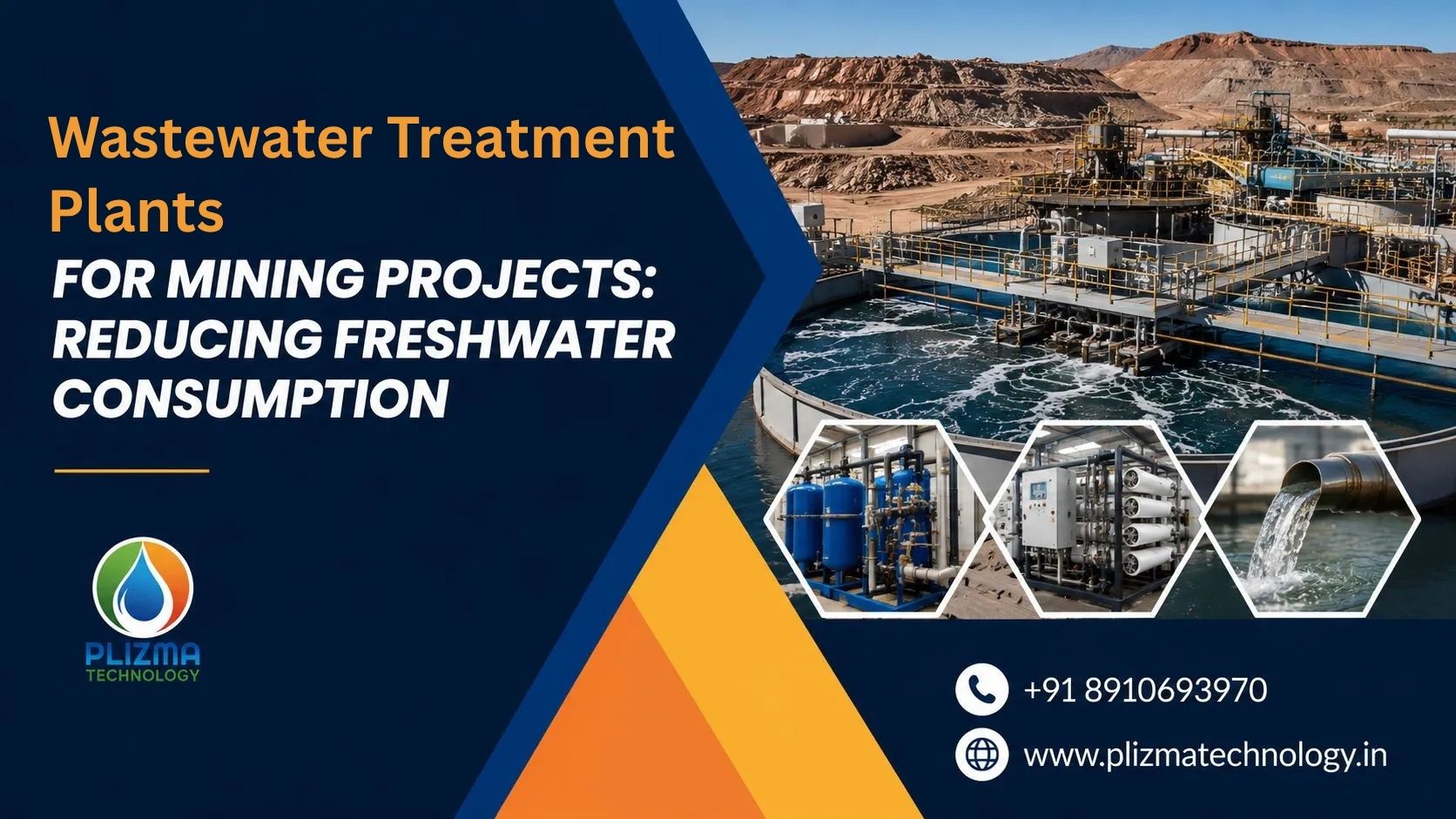
This is where a properly designed mining wastewater treatment plant in Chhattisgarh becomes important. Depending on the wastewater characteristics, the system may include an ETP for mining industry, mine-water treatment, sedimentation, filtration, oil separation, biological treatment and advanced water-recovery systems.
The objective is not only to treat wastewater and meet environmental requirements. The larger opportunity is to recover usable water and reduce dependence on freshwater sources. This becomes especially relevant in mining belts of Chhattisgarh, where coal, iron ore, limestone and bauxite mining activities operate across different geological and climatic conditions.
So, what exactly should a mining wastewater treatment system do?
Let’s understand this from actual project conditions.
Why Water Management Is Important in Chhattisgarh Mining Projects
Mining changes the natural drainage pattern of a site.
Open-cast excavation can intersect groundwater-bearing formations. Rainwater can enter mine pits and become mine water. Washing areas can generate wastewater containing suspended solids and oil. Workshops can contribute oil and grease. Domestic sewage comes from workers, staff colonies and site offices.
These are not one single type of wastewater.
And treating all of them through one process without understanding the source can create operating problems.
The basic mining water management objective therefore becomes:
Freshwater intake → controlled use → wastewater/mine-water collection → treatment → reuse → reduced freshwater demand
This is much more useful than simply treating water and discharging it. A properly planned industrial wastewater treatment system for mining can help industries move towards greater water recovery and reduced freshwater consumption.
What Types of Wastewater Come From a Mining Project?
Before selecting a wastewater treatment plant manufacturer, the wastewater sources need to be separated and characterized.
A typical mining project may have:
- Mine pit water
- Surface runoff from mine areas
- Coal or mineral handling wastewater
- Vehicle and equipment washing water
- Workshop wastewater
- Oil-contaminated drainage
- Beneficiation or process wastewater
- Domestic sewage
- Canteen wastewater
- Stormwater carrying suspended solids
- Water generated from different utility operations
The characteristics are not the same.
Mine water may have high suspended solids and, depending on geology and mining activity, dissolved minerals or metals. Workshop wastewater can contain oil and grease. Domestic sewage has a completely different organic and microbiological profile.
So the first design question is not, “Which ETP plant for mining industry should we install?”
It is:
“Which wastewater is being generated, where, and where can treated water be reused?”
This water balance becomes the foundation of the project.
How a Wastewater Treatment Plant Reduces Freshwater Consumption
The main benefit comes from creating a reuse loop.
Suppose a mine uses freshwater for dust suppression.
After use, some water becomes contaminated and cannot simply be pumped back. But after appropriate treatment through a suitable mining wastewater treatment system, the recovered water can potentially be reused for dust suppression, plantation, equipment washing or other suitable non-potable applications, subject to project-specific quality requirements.
This means the project does not need to continuously replace the entire water requirement with fresh water.
The same concept can be applied to several mining activities.
Treated water may potentially be used for haul-road dust suppression, greenbelt development, vehicle washing, floor washing, gardening, toilet flushing and selected process or utility applications.
The exact reuse application should always be decided from water-quality requirements, not simply from the fact that the water has passed through a wastewater treatment plant.
Mine Water Treatment: The First Major Opportunity
Mine water is sometimes treated as a disposal problem.
Actually, it can become a water-resource opportunity.
When mining intersects aquifers or groundwater-bearing formations, water can accumulate in mine workings and require pumping to continue operations. This pumped water can contain suspended solids and other constituents depending on the geology and mining conditions.
For a mining project, the basic sequence can involve:
Mine pit → pumping → collection/sump → settling → treatment → storage → reuse
The treatment requirement depends heavily on the raw-water analysis.
If the main problem is suspended solids, sedimentation and filtration may be the major treatment stages.
If oil contamination is present, oil and grease separation is required.
If dissolved contaminants are significant, additional chemical or membrane treatment may become necessary.
This is why simply specifying an STP or ETP for mining based on capacity alone is not enough.
Treatment Process for Mining Wastewater
A mining wastewater treatment plant in Chhattisgarh generally needs a combination of physical, chemical and sometimes biological treatment.
1. Screening and Collection
Large solids, plastics, debris and coarse material are removed first.
This protects pumps and downstream equipment.
In mining sites, however, screening is only one part. Drainage design is equally important because uncontrolled stormwater entering the treatment system can suddenly increase hydraulic loading.
2. Equalization and Flow Balancing
Mining operations don’t generate wastewater at exactly the same rate throughout the day.
There can be production fluctuations, rainfall events, equipment washing, mine dewatering and maintenance activities.
An equalization tank provides hydraulic buffering.
This prevents downstream units from receiving sudden flow or pollutant shocks.
Equalization is particularly useful where wastewater characteristics change significantly during the operating cycle.
3. Oil and Grease Removal
Workshop and vehicle-washing wastewater can contain hydrocarbons, lubricants and grease.
An oil-and-grease separator or suitable pretreatment system is therefore required before biological or membrane treatment.
This is particularly important because oil can interfere with biological treatment and foul membranes.
4. Coagulation and Flocculation
Mining wastewater may contain large quantities of suspended mineral particles.
Chemical coagulation destabilizes fine particles, while flocculation helps them form larger particles that can settle.
This is followed by clarification.
The chemical selection should come from actual jar testing and wastewater characteristics rather than assuming one chemical dose will work throughout the year.
5. Clarification and Filtration
The clarification stage separates settled solids from the treated water.
Depending on reuse requirements, additional filtration may use pressure sand filters, multimedia filters, activated carbon, micron filtration or ultrafiltration.
The selected technology depends on the final water-quality requirement and the intended application of the recovered water.
6. Biological Treatment for Sewage
Domestic sewage from mining colonies, offices and worker facilities is different from mine water.
It generally requires an STP for mining camps and residential areas based on biological treatment.
Common technologies include activated sludge, MBBR, SBR, MBR and other biological treatment configurations.
The treated sewage can then be reused for suitable non-potable applications such as flushing, gardening or landscaping, depending on the achieved water quality and applicable requirements.
7. Tertiary Treatment
If the treated water has to be reused for a more demanding application, tertiary treatment can be added.
Depending on the water chemistry, this could include:
UF → RO → disinfection
or other polishing arrangements.
RO should not automatically be added to every mining project. It produces a concentrated reject stream and increases energy and operating requirements. If the reuse application only needs low-TSS water, using RO can unnecessarily increase the treatment burden.
This is one of those places where actual water analysis matters more than a standard RO plant for mining wastewater configuration.
Zero Liquid Discharge and Closed-Loop Water Management
Some mining-related processes can operate with very high levels of internal recycling.
For certain coal-processing and industrial applications, regulatory requirements can call for close-circuit operation and zero liquid discharge under specified conditions.
For a mining project, a closed-loop philosophy can therefore be considered where technically and economically suitable:
Process water → treatment → storage → process reuse
Instead of:
Process water → treatment → discharge → freshwater replacement
The second arrangement loses the resource.
The first keeps it inside the operation.
However, ZLD should not be treated as a slogan. High-TDS streams, RO reject, evaporation systems, sludge and chemical consumption can make zero liquid discharge for mining projects considerably more complex and energy intensive. The correct approach depends on the project’s water balance and discharge/reuse requirements.
Water Balance Is More Important Than Plant Capacity
One common mistake in wastewater projects is starting with:
“We need a 500 KLD plant.”
That number alone doesn’t tell enough.
The engineering team should first prepare a water balance:
Freshwater intake
↓
Process / mining / utility use
↓
Wastewater generation
↓
Collection and segregation
↓
Treatment
↓
Treated-water storage
↓
Reuse
↓
Freshwater requirement reduced
The water balance should identify each source and destination.
This helps determine how much wastewater actually needs treatment, how much water can realistically be recovered and where the recovered water will go.
It also prevents clean rainwater from unnecessarily entering the ETP and increasing the plant capacity requirement.
Rainwater Management Is Part of Wastewater Management
Chhattisgarh receives significant monsoon rainfall, and mining projects have large disturbed areas.
During heavy rainfall, runoff can carry fine coal, soil, mineral particles, suspended solids, oil from roads and workshops and other site contaminants.
If this water is mixed with wastewater continuously, treatment plant hydraulics become difficult.
Separate drainage arrangements, settling ponds, sedimentation structures and controlled stormwater routing therefore become important.
The objective is simple:
Keep clean stormwater clean. Treat contaminated runoff separately.
This can reduce unnecessary treatment volumes and operating costs for a mining ETP in Chhattisgarh.
Regulatory Compliance in Chhattisgarh
A mining project has to consider both central environmental requirements and state-level consent requirements.
The Chhattisgarh Environment Conservation Board , or CECB, is responsible for pollution-control functions in the state and operates the online consent management system for regulated activities.
For projects discharging wastewater, the applicable consent conditions and environmental clearance conditions need to be checked for that particular project.
This is important because there is no single wastewater quality number that can safely be applied to every mining operation.
The applicable requirement can depend on:
- Type of mine
- Process involved
- Receiving environment
- Discharge location
- Reuse application
- Environmental clearance conditions
- CECB consent conditions
- Applicable CPCB standards
So plant design should start from raw-water analysis + water balance + applicable consent/EC conditions, not only from an assumed KLD capacity.
Automation and Online Monitoring
Mining sites are often large and distributed.
The treatment plant may be located away from the main administration building, while pumping stations, sumps and reuse points are spread across the mine.
Automation can help manage this.
A modern industrial wastewater treatment plant may use flow meters, level sensors, pH monitoring, turbidity monitoring, pressure sensors, pump-status monitoring, PLC/SCADA, remote alarms and data logging.
This gives operators better visibility of water movement and treatment performance.
But automation doesn’t replace sampling and laboratory verification.
Sensors drift, probes foul, pumps fail, and mining water chemistry can change quickly.
A dashboard showing green colour is not proof of compliance.
The actual water quality still has to be verified.
Common Problems in Mining Wastewater Treatment Plants
Mining wastewater treatment sounds straightforward until the plant starts operating.
Some common problems are:
High Suspended Solids
Fine mineral particles can overload clarifiers and filters.
Sudden Monsoon Flows
Stormwater can hydraulically overload treatment systems if drainage is not properly segregated.
Variable Water Chemistry
Groundwater chemistry and process conditions can change during mining.
Oil Contamination
Workshop wastewater can damage biological and membrane processes if pretreatment is inadequate.
Sludge Generation
Coagulation and clarification create sludge that needs proper handling and disposal.
Poor Segregation
Mixing sewage, mine water, stormwater and process wastewater can make treatment unnecessarily expensive.
Reuse Without Adequate Quality Control
Treated water should not be reused for an application simply because it “looks clean.” The required quality depends on where it is being used.
The Practical Mining Water Strategy
A good mining wastewater treatment system therefore looks beyond installing an ETP.
The system should be planned around five connected areas.
First, water conservation.
Freshwater consumption should be reduced at source wherever practical.
Second, wastewater segregation.
Different wastewater streams should be kept separate where this improves treatment and reuse.
Third, treatment.
The treatment process should match the actual contaminants present.
Fourth, reuse.
Realistic internal reuse applications should be identified before finalising the treatment system.
Fifth, monitoring.
Freshwater intake, wastewater generation and treated-water reuse should be measured.
This converts wastewater treatment from a compliance-only system into a water-management system.
Why This Matters for Chhattisgarh Mining Projects
Chhattisgarh has an important mining and mineral-processing economy, including coal, iron ore, limestone and bauxite operations.
The scale and geographic spread of mining means water management cannot be treated as one standard engineering package.
A mine located near a major industrial complex may have completely different water-reuse opportunities from a remote iron-ore mine.
A coal mine with dewatering may have a large mine-water stream.
A beneficiation plant may generate process wastewater with a different solids and chemical profile.
A limestone mine may have comparatively different wastewater characteristics.
So the treatment system has to follow the mine’s water balance and wastewater chemistry.
Not the other way around.
How to Choose a Wastewater Treatment Plant Manufacturer in Chhattisgarh
Choosing a wastewater treatment plant manufacturer in Chhattisgarh should involve more than comparing equipment prices.
The manufacturer should understand mining wastewater characteristics, mine-site conditions, water reuse requirements, sludge handling, process variations and long-term operation.
Before selecting a supplier, mining companies should evaluate:
- Experience with mining wastewater treatment
- Ability to conduct or review wastewater analysis
- Site-specific process design
- ETP and STP integration where required
- Water-reuse and recovery solutions
- Sludge-management arrangements
- PLC and SCADA automation
- Energy-efficient equipment selection
- Commissioning and operator support
- After-sales maintenance and technical support
A suitable ETP manufacturer for mining industry should therefore design the system around the actual wastewater and water balance instead of offering a generic plant based only on KLD capacity.
Conclusion
Wastewater treatment plants for mining projects are no longer only about removing pollutants before discharge.
The larger requirement is reducing freshwater dependence while maintaining environmental compliance.
For mining projects in Chhattisgarh, this can involve mine-water treatment, sedimentation, oil separation, ETPs, STPs, tertiary filtration, treated-water storage and carefully planned reuse.
The strongest approach is to first understand where freshwater is being consumed, where wastewater is generated and which streams can realistically be recovered.
Mine water can become a usable resource.
Treated sewage can support non-potable applications.
Process water can be recycled.
Stormwater can be managed separately.
And freshwater intake can be reduced.
But all this depends on proper segregation, treatment selection, water-quality monitoring and project-specific regulatory conditions.
For mining projects, the real target therefore should not simply be:
“Install a wastewater treatment plant.”
It should be:
“Treat the wastewater, recover the water, reuse it safely, and reduce the amount of freshwater the mine needs to take in.”
That is where wastewater treatment becomes actual water conservation.
Frequently Asked Questions
Q1. Why is wastewater treatment important for mining projects in Chhattisgarh?
Mining can generate mine water, process wastewater, workshop wastewater, sewage and contaminated runoff. A properly designed mining wastewater treatment plant allows these streams to be managed safely and, where water quality permits, reused for suitable applications instead of continuously replacing them with freshwater.
Q2. Can treated mine water be reused?
Yes, potentially. The reuse application depends on the water chemistry and required quality. Mine water may be treated and reused for applications such as dust suppression, plantation or other suitable non-potable purposes after confirming the required quality.
Q3. Is an ETP enough for an entire mining project?
Not necessarily. Mine water, domestic sewage, workshop wastewater and process wastewater can have very different characteristics. A project may require a combination of settling systems, ETP for mining wastewater, STP, oil separation, filtration and additional polishing.
Q4. Does every mining project require RO?
No. RO should be selected based on dissolved-solids levels and the required reuse quality. Installing RO where simpler treatment is sufficient can increase energy consumption, chemical requirements and reject-management problems.
Q5. How can a mine measure freshwater savings?
The project should install flow measurement at major freshwater-intake points and reuse points and maintain a water balance. Comparing freshwater intake before and after treatment and reuse gives a much better picture than measuring only the ETP outlet.
Q6. What regulatory bodies are relevant for mining wastewater in Chhattisgarh?
The project needs to consider applicable requirements from central authorities such as CPCB and MoEFCC as well as the Chhattisgarh Environment Conservation Board, including applicable Consent to Establish, Consent to Operate and project-specific environmental-clearance conditions.
Industry Note
For mining projects, wastewater treatment works best when it is designed as part of the overall water balance rather than as an isolated pollution-control unit. The engineering focus should remain on segregation, recovery, reuse, reliable treatment and measurable reduction in freshwater consumption.
Plizma Technology approaches mining wastewater treatment around practical site conditions, reliable treatment, manageable O&M and opportunities for treated-water reuse, because remote and large-scale mining wastewater infrastructure has to continue working long after installation and commissioning.