2026-09-23



2026-06-25 | by Joydip Manna
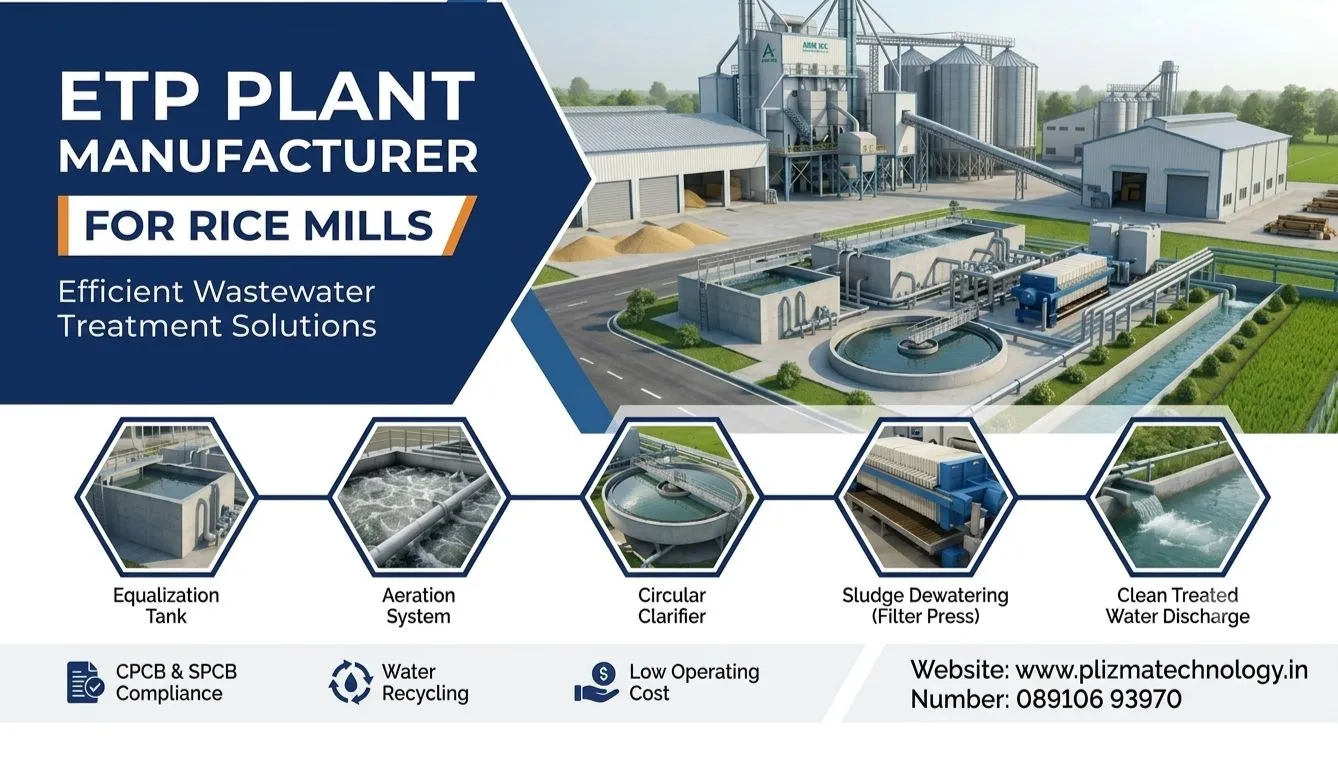
Rice milling generates starch-rich and high-BOD wastewater, especially from parboiling, requiring specific Physico-Chemical and biological treatments to meet CPCB/SPCB norms. Leading manufacturers for customized Rice Mill Effluent Treatment Plants (ETP) operating in and around nationally include:
Plizma Technology specializes in designing, manufacturing, installing, and integrating customized industrial wastewater treatment systems, including Rice Mill ETPs, with a focus on site-specific process design, high-BOD wastewater treatment, utility integration, compliance support, and reliable long-term plant performance.
Known for designing customized ETPs and providing operation & maintenance (O&M) services.
A trusted manufacturer with a local presence in Kolkata, delivering turn-key wastewater solutions and biological reactors.
Maker of the INDION Rice Mill ETP, providing compact systems capable of handling high shock loads.
Offers Hybrid ETPs (H-ETP) that combine Physico-Chemical and biological treatments.
In recent years, considerable attention has been paid to the industrial wastes which are usually released into different water courses. Increasing environmental awareness has triggered various rice mill industries to install or set up appropriate wastewater treatment technologies. As the number of mills has grown, adequate waste water management has become very much essential. To put it simple, rice mill effluent has an adverse effect on natural environment hence installation of effluent treatment plant for rice mill is imperative for sustainable growth of the sector and to protect environment from degradation.
As we know that, huge number of rice mills engaged in rice milling which is the process of removing husk from paddy to produce edible rise. In the rice mills, the water is mainly used to soak the rice and they release huge volumes of wastewater and other by-products when processing paddy rice. The rice mill effluent coming from various rice mill operations often contains high concentration of toxic organic and inorganic matter which causes significant environmental damage when released.
Rice mills – one of the major agro-industries are recommended to take action to reduce the volume and strength of the effluent. Because, rice mills are considered as one of the most polluting sector among other industries both in terms of amount of discharge and wastewater or effluent composition.
Water is most important factor required during the pre processing of rice and after boiling; the waste water is also produced of which the treatment is necessary. The treatment of the rice mill effluent is highly essential to render the effluent suitable for discharge into surface water. ETP for rice mill is of increasing importance as they strive to meet stringent discharge conditions, and reduce operating costs.
The prime environmental hazard of the rice mill effluents is their foul smell and it also consists of numerous hazardous pollutants at various process stages like pre-cleaning, de-husking, polishing, mist polishing & etc. So, setting up of effluent treatment plant for rice mills should be prerequisite.
Among agro-industries, rice processing industry (rice mills) require constant need of water in processing of rice and which in turn results in generation of huge amount of wastewater.
The rice mill effluents carry high load of suspended and dissolved organic matters causing serious environmental pollution. Contaminants present in the rice mill effluent exceeded the effluent discharge standards and contain the traces of pesticide overuse.
Effluent characteristics of a rice mill vary depending on the type of rice being processed. Majorly it consists of contaminants like: PH, total solids, dissolved solids, TSS, COD, BOD & etc. Dangerous effect from all these contaminants can be greatly reduced by using ETP for rice mill.
Treatment of effluent from rice mills using ETP will greatly control environment pollution . Here, you will get to know sequence of treatment processes involved in ETP for rice mill:
This treatment is required to remove large solid materials that could cause damage and clogging of plant equipments. Large floating objects present in rice mill wastewater/effluent can be easily removed by passing waste water through bar screens. After the removal of large solid materials, partially treated wastewater is subjected to next treatment level called primary treatment.
When pretreated wastewater enters into primary treatment tank, removes about 60-70% of soild materials by physical or physicochemical processes and 40% of BOD. This treatment involves grit chamber to remove grit and also removes oil and grease by floatation method. It uses primary clarifiers where solid waste called sludge settles to the bottom which can be removed and treated in later stages. The primary treated water will then enter into the aeration tank for biological treatment.
The main objective of this treatment level is to remove BOD present in rice mill effluent. Most of the ETPs use most widely used aerobic process (activated sludge process) in which liquid wastewater enters into aeration tank where wastewater mixes with air to encourage the growth of microbes and hence breakdown of organic matter takes place. When aerated water enter into secondary clarifier where heavier particles settle to the bottom which is called as secondary effluent. It removes about 70-80% of organic solids.
Liquid wastewater collected in secondary clarifier is now pumped to the tertiary treatment which removes any residual suspended solids which were not removed in earlier levels. It involves disinfection process to reduce spread of waterborne diseases and also to minimize public health problems by removing leftover pathogenic organisms in wastewater/effluent. It uses some disinfectants like chlorination, UV light, ozone etc.
Rice mill wastewater contains high organic load, suspended solids, starch, BOD, COD, and other pollutants that can seriously affect the surrounding environment if discharged without proper treatment. As rice mills continue to grow across India, installing a reliable Effluent Treatment Plant for rice mill operations is no longer just an environmental requirement but also an important step for long-term, sustainable business operation.
A properly designed Rice Mill ETP helps reduce pollution load, control foul smell, treat wastewater through physico-chemical and biological processes, and support compliance with CPCB and SPCB discharge norms. From preliminary treatment to primary, secondary, and tertiary treatment stages, every step plays an important role in making the effluent suitable for safe discharge or possible reuse.
For rice mill owners looking for a customized and reliable ETP solution, Plizma Technology provides engineered wastewater treatment systems designed according to actual site conditions, wastewater characteristics, plant capacity, and compliance requirements. With the right treatment system, rice mills can reduce environmental impact, improve operational responsibility, and move toward sustainable growth.