2026-09-28



2026-08-19 | by Joydip Manna
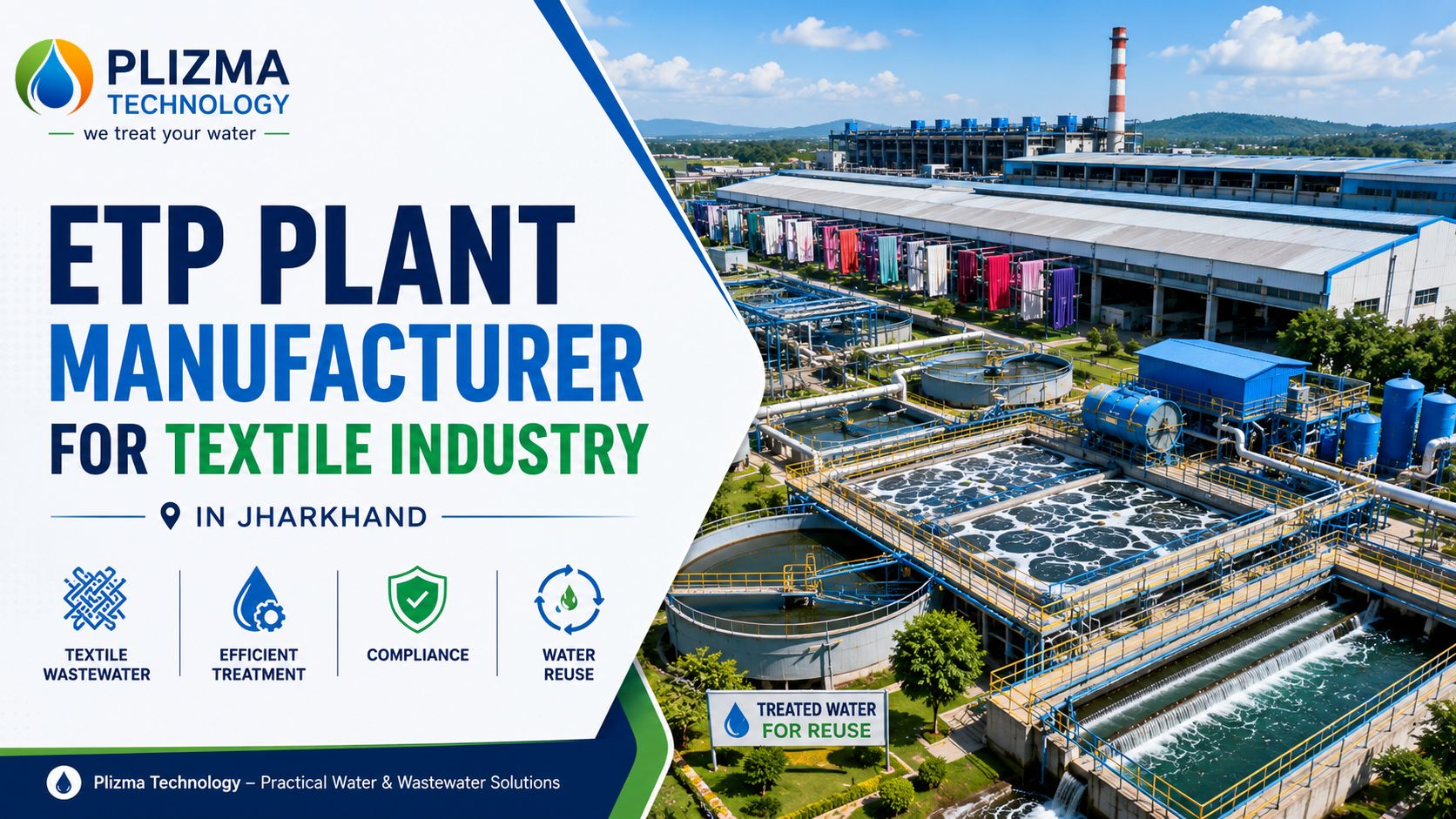
Textile industries are growing in Jharkhand and along with production, one problem keeps coming again and again — industrial wastewater.
Dyeing, bleaching, washing, printing and finishing activities generate wastewater with colour, chemicals, suspended solids, organic matter and dissolved pollutants. If this water is released without proper treatment, it can affect nearby water sources, soil and the surrounding environment.
This is where an ETP plant manufacturer for textile industry in Jharkhand becomes important.
But selecting an ETP is not simply about finding a plant with the required KLD capacity. Textile wastewater changes from one process to another. The treatment plant has to be designed according to the actual wastewater, chemicals used, production process and the quality of water required after treatment.
So, what exactly should a textile industry look for before selecting an ETP manufacturer? Let us understand.
An Effluent Treatment Plant, commonly called ETP, is a treatment system used to treat wastewater generated from industrial processes.
In textile industries, this wastewater can come from dyeing, washing, bleaching, printing and other processing operations.
The wastewater may contain:
The ETP removes or reduces these pollutants through different treatment stages.
The main purpose is straightforward. Treat the industrial effluent before it is discharged or reused.
But in actual textile plants, it is not always straightforward because wastewater characteristics can change during production. This is why a properly designed ETP becomes important.
One textile unit may not generate the same wastewater as another textile unit.
A dyeing plant can have high colour and dissolved salts. A washing process can have different organic and suspended-solid loads. Printing and finishing operations can introduce still other chemicals.
This changing wastewater makes textile ETP design more complicated than simply installing a standard treatment package.
The plant needs to handle variation in:
If these variations are not considered during design, treatment performance can become unstable.
For this reason, the ETP plant manufacturer should first understand the textile process and wastewater analysis, then finalize the treatment process.
A textile ETP normally works through several treatment stages. The exact arrangement depends on the wastewater characteristics and final treated-water requirement.
The wastewater first passes through screening.
Large materials such as fibres, fabric pieces, plastics and other debris are removed. This looks like a basic stage, but it is important because these materials can block pumps, pipelines and other equipment.
After screening, the wastewater moves towards equalization.
The equalization tank is one of the important units in a textile ETP.
Why?
Because textile wastewater does not always come at a constant flow or concentration.
The tank receives and mixes wastewater so that sudden changes in flow, pH and pollutant loading are reduced before the wastewater enters the next treatment stage.
Proper equalization helps protect downstream chemical and biological treatment from sudden shock loads.
Textile wastewater can have changing pH depending on the chemicals and processes used.
Neutralization systems adjust the pH to a suitable range for the following treatment stages.
Acid or alkali dosing may be used depending on the incoming wastewater condition.
The dosing system has to be controlled carefully. Too little dosing will not correct the pH, while excessive dosing increases chemical consumption and can affect downstream treatment.
Now the chemical treatment begins.
Fine suspended particles and colour-causing substances can be difficult to settle naturally. Coagulation destabilizes these particles, and flocculation allows them to join together into larger flocs.
These flocs can then be separated in a clarifier.
The selection of chemicals should not be based only on standard practice. Jar testing and actual wastewater characteristics can help determine suitable chemicals and dosing.
The flocs formed during chemical treatment are separated through clarification.
The heavier solids settle down as sludge while clarified wastewater moves forward.
This sludge cannot simply be ignored. It needs proper collection, dewatering and disposal according to applicable requirements.
Sludge handling therefore forms an important part of the complete ETP system.
After chemical treatment, biological treatment can be used to reduce biodegradable organic pollutants.
Microorganisms break down organic matter under controlled conditions. Aeration equipment supplies oxygen and maintains mixing inside the biological treatment system.
This stage needs stable operation.
If the incoming wastewater suddenly contains excessive chemicals or receives a major change in organic loading, biological activity can be affected. Again, this is why equalization and proper upstream treatment matters.
The biological solids are separated from the treated water in the secondary clarifier.
Settled biological sludge can be returned to the biological process where required, while excess sludge is removed for further handling.
The clarified water can then move towards tertiary treatment.
Sometimes conventional ETP treatment is not enough for the required final water quality.
If the textile industry wants better-quality treated water for reuse, additional treatment can be installed.
Depending on the requirement, this can include:
The important point is that tertiary treatment should be selected according to the actual reuse requirement.
RO, for example, should not be added simply because it is an advanced technology. If the treated water needs to meet a particular quality for process reuse, then membrane treatment can be evaluated accordingly.
Today, industries are looking beyond only wastewater discharge.
Freshwater consumption is becoming an important operational concern, and textile processing can consume significant quantities of water.
A properly designed treatment and recycling system can allow treated water to be reused for suitable applications, depending on the required quality.
This can help reduce freshwater demand and wastewater discharge.
Where higher recovery is required, additional UF, RO and other treatment stages may be considered. In some cases, industries may also evaluate ZLD systems depending on regulatory and process requirements.
So, an ETP can become more than a pollution-control system. It can also become part of the industry’s water-management system.
This is where industries need to be a little careful.
Many manufacturers can provide an ETP quotation. But the quotation alone does not tell whether the system will actually perform properly after commissioning.
Before selecting an ETP manufacturer, textile industries should check:
These questions are more important than simply asking, “What is the ETP price?”
An ETP needs attention after installation.
Pumps need maintenance. Blowers need checking. Dosing systems need calibration. Filters need backwashing. Sludge needs to be removed. Biological systems need monitoring.
And textile wastewater can change quickly.
If colour starts passing through the clarifier, chemical dosing may need adjustment. If biological treatment becomes unstable, the reason needs to be identified. If membranes are installed, fouling and recovery need to be monitored.
This is why technical support in Jharkhand can become an important part of manufacturer selection.
For textile industries around Ranchi, Jamshedpur, Bokaro, Dhanbad and other industrial areas, the practical response time of the service team can matter when the ETP is facing an operational problem.
There is no single ETP capacity that is correct for every textile factory.
Capacity depends on actual wastewater generation.
The design should consider:
If the plant is undersized, it can become overloaded.
If it is unnecessarily oversized, capital cost and operating cost increase.
So, the ETP plant manufacturer should calculate the capacity from actual process data instead of using a generic capacity assumption.
Modern ETPs can also use PLC and SCADA systems for better monitoring and control.
Parameters such as pH, flow, tank level, pumps, blowers and dosing systems can be monitored through automation.
This helps operators identify abnormal conditions faster.
But automation is not a replacement for trained operators.
Industrial wastewater treatment still needs people who understand chemical dosing, biological treatment, sludge characteristics and the actual behaviour of the wastewater.
A fully automated system with poor operation knowledge can still perform badly. This is a common practical point which should not be overlooked.
Installing an ETP does not automatically mean an industry is compliant.
The plant must be properly designed and operated, and treated effluent needs to meet the applicable requirements for its intended discharge or reuse.
CPCB has prescribed standards for textile-industry effluent, while specific conditions can also depend on the applicable consent and discharge arrangement.
Regular monitoring, maintenance and proper operating records therefore become important.
The ETP should be treated as an operating system, not just a civil construction project.
Finding the right ETP plant manufacturer for textile industry in Jharkhand requires looking beyond the initial plant quotation.
Textile wastewater contains different pollutants depending on the production process, and its flow and characteristics can change throughout the day. A suitable ETP therefore needs proper equalization, chemical treatment, biological treatment and, where required, tertiary or membrane treatment.
The manufacturer should understand the textile process, wastewater analysis, required treated-water quality and long-term operation.
A properly designed ETP can help textile industries control pollution, support regulatory compliance and create opportunities for water recycling and reuse.
At the end, the right ETP is not necessarily the plant with the biggest equipment or the lowest price. It is the system that is designed around the actual wastewater and can continue performing properly after commissioning.
For textile industries in Jharkhand, Plizma Technology approaches ETP requirements from this practical side — understanding the wastewater first, selecting the treatment process next and then designing the plant around the actual industrial requirement.
A textile ETP can be designed to reduce suspended solids, BOD, COD, colour, chemicals and other process-specific pollutants. The exact treatment depends on wastewater characteristics.
It is often an important part of textile ETP design because wastewater flow and pollutant concentration can vary considerably during different production processes.
No. RO depends on the required treated-water quality and whether the water is being considered for a particular reuse application.
Yes, treated wastewater can potentially be recycled for suitable industrial applications when the treatment quality is appropriate for that use.
Check wastewater-analysis capability, textile-industry experience, process design, equipment quality, treatment guarantees, sludge management, automation and after-sales technical support.
ETPs require continuous operation and maintenance. Quick technical support can be useful when problems occur with dosing, aeration, clarification, filtration, sludge handling or other treatment stages.
Industrial wastewater treatment is no longer only about installing a plant at the factory boundary and forgetting about it.
For textile industries, the treatment system has to work with the production process. Wastewater changes, chemicals change, production changes — and the ETP needs to handle these realities.
That is why selecting the right ETP plant manufacturer in Jharkhand is an important technical decision, not simply a purchasing decision.
2026-09-28
2026-09-23